
4 Reales Carlos y Juana: The First Silver Coins of the Americas
The 4 Reales Carlos y Juana: The First Silver Coins of the Americas is worth between $370 and $429 MXN depending on its grade of preservation.
Prices updated: August 2026
Viceroyalty · Mexico City Mint · Assayer R
Viceroyalty · Mexico City Mint · Assayer R
The 4 Reales Carlos y Juana: The First Silver Coins of the Americas is worth between $370 and $429 MXN depending on its grade of preservation.
Prices updated: August 2026
How much is the 4 Reales Carlos y Juana: The First Silver Coins of the Americas worth?
The estimated value of the 4 Reales Carlos y Juana: The First Silver Coins of the Americas ranges from $370 (circulated, XF) up to $429 (official blister pack), with $408 as a reference for an uncirculated (UNC) piece. The estimate is based on the official mintage and the historical behavior of the family.
The real price depends on four factors: the grade of preservation (a circulated piece is worth the low end of the range; an uncirculated one, or one still in its official blister pack, the high end), the finish (satin vs mirror/proof), the rarity within the series based on the mintage, and the metal spot price on the day of the deal when the piece is silver or gold. Check the value-by-grade table above and compare with equivalent pieces before buying or selling.
Where to buy or sell this coin?
Browse the national directory of numismatic shops or the community forum to trade directly with other collectors.
Description
If you have a 4 Reales Carlos y Juana in hand, you are holding one of the first silver coins struck in the Americas. Worn examples trade in the low hundreds of dollars, but sharp, well-struck pieces regularly clear 1,000 to 5,000 dollars at auction, and exceptional rarities go higher. Here is what actually drives that number in 2026.
What this coin is
The 4 Reales Carlos y Juana was minted at the Casa de Moneda de México (the Mexico City mint), the oldest mint in the Americas, established in 1535. The "Carlos y Juana" refers to Charles I of Spain (Emperor Charles V) and his mother Juana, who reigned jointly in name. These are the earliest colonial silver coins produced in what is now Mexico, struck roughly from the 1530s into the 1570s.
The "4 reales" is the denomination. It sits in the middle of the colonial silver series that ran from 1/2 real up to 8 reales (the famous "pieces of eight"). See the full Colonial Reales series (1/2 to 4 reales) for how the denominations relate.
Specifications (check yours against these)
| Spec | Value |
|---|---|
| Denomination | 4 Reales |
| Weight | 13.46 grams |
| Diameter | 31 mm |
| Metal | Silver, .900 fine (90% silver) |
| Edge | Plain (unmilled) |
| Mint | Mexico City (Casa de Moneda de México) |
| Assayer | R |
| Period | Colonial / Viceroyalty of New Spain |
These early pieces were struck by hand, so real examples are often slightly irregular in shape and off-center. That is normal for the period, not a defect. Weight and diameter that fall far outside 13.46 g and 31 mm are a warning sign.
What it's actually worth
Value on these coins is driven by four things: how well the design struck up, wear, whether it has been cleaned, and third-party certification. Because these were hand-struck almost 500 years ago, a fully clear strike showing the full shield and legend is scarce, and that is where the money is.
| Condition | Typical value (USD) |
|---|---|
| Heavily worn / partial strike | 100 to 400 |
| Clear circulated, readable design | 400 to 1,500 |
| Sharp strike, minimal wear | 1,500 to 5,000 |
| Certified high grade / rare variety | 5,000 and up |
At the top end, standout early Mexican colonial silver has crossed into five figures at Heritage Auctions and Stack's Bowers sales, especially for pieces with exceptional strike and eye appeal for the type. Most inherited examples, though, land in the first two rows of that table. Do not assume yours is the record piece until it is graded.
As 90% silver, the coin also has a hard floor at melt value. At 13.46 grams of .900 silver, the metal alone is worth only a few dollars, so with this coin the numismatic value is almost always far above the silver. That is the opposite of a modern bullion piece.
The myth to kill
Because these are "almost 500 years old," a lot of people assume any 4 Reales Carlos y Juana is worth a fortune. Age alone does not do that. A worn, cleaned, or damaged example is a few hundred dollars, period. What multiplies value is a strong strike, original surfaces (not scrubbed shiny), and a clean grade from NGC or PCGS. A cleaned coin can lose more than half its value versus the same coin left original.
How to tell if yours is genuine
Counterfeits of early colonial silver exist, so verify before you celebrate or sell:
- Weight and size. It should be close to 13.46 grams and 31 mm. Cast fakes are often light or the wrong diameter.
- Ping test. Real .900 silver gives a long, high ring when balanced on a fingertip and lightly tapped. A dull, short sound suggests base metal.
- Strike character. Genuine hand-struck coins show slightly uneven, irregular edges and honest wear. Fakes often look too uniform or have soft, mushy detail from casting.
- Certification. For anything you think is worth more than 500 dollars, send it to NGC or PCGS for grading and authentication. That certification is what serious buyers pay for.
Use our coin condition and grading guide to judge wear before you get an appraisal.
Where to sell it
For a coin at this level, sell where buyers actually understand early colonial silver:
- Major US auction houses (Heritage, Stack's Bowers) for certified or clearly high-grade pieces. They reach the collectors who pay top dollar for this type.
- Established coin dealers who handle world and colonial coins, for a quick, fair in-person offer.
- Vetted collector marketplaces. Trade only with buyers who will inspect the piece and its weight first, and always show clear photos of the obverse, reverse, and edge.
Get it authenticated first. On a coin where a clean strike can be the difference between 400 and 4,000 dollars, selling raw to the first bidder usually leaves money on the table.
Have one of these and want a second opinion on grade or authenticity? Post clear photos of both sides and the edge in the Pesoteca forum and let collectors who handle colonial silver weigh in before you sell.
Historical context
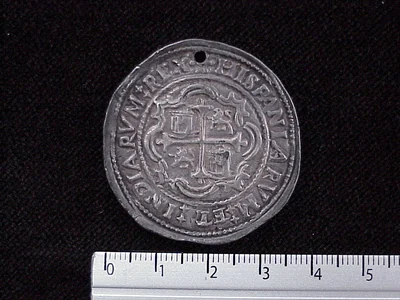
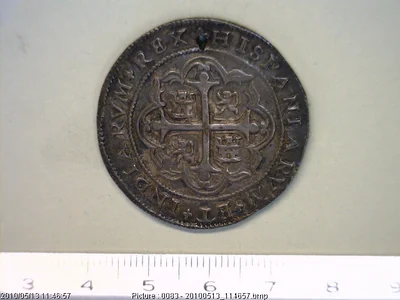
This piece belongs to the first series of the Mexican Mint, struck in the name of Carlos I of Spain and his mother Juana I of Castile, known as the Mad. They are the first metal coinages in the Americas, authorized by the Royal Decree of May 11, 1535, and produced between 1536 and 1572 in the palace of the Marqués del Valle in Mexico City.
The 4 reales denomination theoretically weighed 13.54 grams with a silver fineness of 0.9028 (early) / 0.903 (late). The 4 reales, or half peso, was a coin of regional commerce: buying small livestock, paying for short freight, and rents in the towns and villages of the viceroyalty.
The R mark appears on planchets of the first series bearing that initial. It is paired with the shield-type reverse (lions and castles) typical of the heraldic arrangement of Castile and León under the early House of Austria.
The 4 reales of the first series have a generous size that better preserves the design of the royal shield and the Pillars of Hercules with the motto PLVS VLTRA. When buying peer to peer, it is worth checking that the planchet preserves an identifiable design on both faces, and consulting public catalogs before accepting a con artist's markup.
This piece belongs to the era
Colonial / Virreinato →Explore all the Mexican coins of this era, their historical context and how they connect to the monetary system of the period.
Value range of this piece
Market estimate: $370 - $429 MXN depending on the grade of preservation (typical range between a circulated and an uncirculated piece).
See the full breakdown by grade (VG, F, VF, EF, AU, MS-60, MS-63, MS-65) for the whole series →
Same denomination, other years
4 reales Plata 0.900 · Reales Coloniales (1/2 a 4 reales)
Frequently asked questions
How much is a 4 Reales Carlos y Juana worth?
It depends heavily on strike and condition. Heavily worn or partially struck examples run about 100 to 400 dollars. Clear circulated coins go 400 to 1,500 dollars, and sharp, well-preserved or certified pieces reach 1,500 to 5,000 dollars or more. Because these were hand-struck almost 500 years ago, a fully clear strike is where the real money is. Get it graded by NGC or PCGS for an accurate value.
Is the 4 Reales Carlos y Juana rare?
It is genuinely scarce, especially in high grade. These were among the first silver coins struck in the Americas at the Mexico City mint in the 1500s, and they were made by hand. Well-worn examples show up regularly, but pieces with a full, clear strike and original surfaces are hard to find, which is exactly what drives the strong prices at auction.
How can I tell if my 4 Reales Carlos y Juana is genuine?
Start with weight and size: it should be near 13.46 grams and 31 mm. Real .900 silver gives a long, high ring when lightly tapped, while fakes sound dull and short. Genuine hand-struck coins have slightly irregular edges and honest wear; cast fakes often look too uniform or mushy. For anything worth over 500 dollars, certification from NGC or PCGS is the definitive check.
Where can I sell a 4 Reales Carlos y Juana?
For a coin at this level, use a major US auction house like Heritage or Stack's Bowers, or an established dealer who handles world and colonial coins. Photograph the obverse, reverse, and edge, and get it authenticated before selling, since a clean strike can be the difference between a few hundred and several thousand dollars. Avoid selling raw to the first bidder.
Conversation
0 comments
Sources
Images for informational and educational purposes, attributed to their original source. Reference values; the real price depends on the grade, the specific variant and demand.
Loading comments…