
1994 Mexico 5 Centavos (Stainless Steel): Value & Facts
Prices updated: August 2026
Centavos stainless steel 1994.
Centavos stainless steel 1994.
Design
Banxico
Reverse
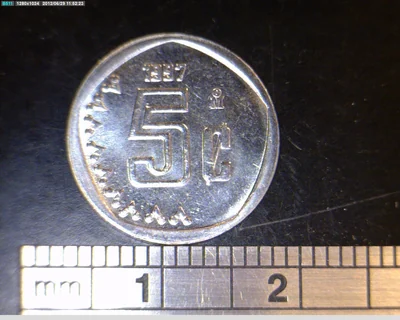
Reverse of the 5 stainless steel 1994 piece. Detail of the die cataloged by Banxico in its Numismatic Collection.
Obverse
Obverse with the Mexican National Coat of Arms and the legend "ESTADOS UNIDOS MEXICANOS" per official convention. Struck by the Mexican Mint under Banxico decree.
How much is the 1994 Mexico 5 Centavos (Stainless Steel): Value & Facts worth?
The market value of the 1994 Mexico 5 Centavos (Stainless Steel): Value & Facts is not yet documented with enough data to give a firm range. Weigh and measure your piece, compare it against the specifications, and check the forum for a second opinion.
The real price depends on four factors: the grade of preservation (a circulated piece is worth the low end of the range; an uncirculated one, or one still in its official blister pack, the high end), the finish (satin vs mirror/proof), the rarity within the series based on the mintage, and the metal spot price on the day of the deal when the piece is silver or gold. Check the value-by-grade table above and compare with equivalent pieces before buying or selling.
Where to buy or sell this coin?
Browse the national directory of numismatic shops or the community forum to trade directly with other collectors.
Description
Let's be honest up front: a 1994 Mexican 5 centavos in the condition most people find it is worth a few cents, not a fortune. It is a common circulation coin. The only versions that fetch a couple of dollars are pristine, uncirculated pieces or genuine mint errors. Here's exactly what yours is worth and how to check.
Quick answer: what it's worth in 2026
A worn, circulated 1994 stainless steel 5 centavos is worth its face value, effectively a few US cents. A clean, uncirculated example with full luster and no scratches can sell to a collector for roughly 1 to 3 US dollars. Certified high-grade examples (graded MS66 or better by NGC or PCGS) can reach a bit more, but this is a modest coin, not a rarity.
If someone tells you this coin is worth hundreds or thousands of dollars, they are wrong unless it carries a verified minting error. Millions were struck.
What this coin actually is
The 5 centavos is one of the smallest pieces in the coin system Mexico launched with the "Nuevo Peso" (New Peso) reform. In 1993, Mexico dropped three zeros from the old peso and rebuilt the decimal system, which needed fresh centavo coins for making change. The 5 centavos was the humblest member of that family.
It was struck at the Casa de Moneda de México (the Mexican Mint) in stainless steel, which made sense for such a low-value coin: cheap to produce and durable enough for daily change.
Technical specifications
| Feature | Detail |
|---|---|
| Denomination | 5 centavos |
| Year | 1994 |
| Composition | Stainless steel |
| Weight | 1.58 g |
| Diameter | 15.5 mm |
| Edge | Plain (smooth) |
| Mint | Casa de Moneda de México |
Why it's not a rarity (and where the small value comes from)
This coin was made in large numbers for everyday use, so there is no scarcity in circulated grades. The collector interest is narrow: people building a complete set of first-design centavos from the New Peso era.
Here's the catch that gives top examples a little value. Because the coin is stainless steel, most surviving pieces got scratched, spotted, or lost their shine in circulation. Finding one in high grade with no marks and full mint luster is harder than you'd expect for such a modest coin. That's where the 1 to 3 dollar figure comes from: not rarity of the coin, rarity of the condition.
If you want to understand how condition drives price on ordinary coins like this, our guide to how to grade Mexican coins explains the scale collectors use. For context on the reform that created this piece, see our overview of the New Peso coin series.
Do error versions exist?
Yes. Genuine minting errors (off-center strikes, die rotation, double strikes, and design varieties) can multiply the value of an otherwise common coin. The problem is that most "errors" people spot on social media are actually post-mint damage: dings, corrosion, or wear, not mistakes made at the mint. Damage lowers value; a real factory error raises it.
If you think yours has a true error, don't guess. Post clear photos in the Pesoteca forum and let collectors weigh in before you assume it's worth money.
How to tell if yours is genuine
For a common coin like this, fakes are rare because there's no profit in faking it. Still, if you want to confirm authenticity, do this:
- Weigh it on a jewelry scale. It should come in at 1.58 g.
- Measure the diameter with calipers. It should be 15.5 mm.
- Check the edge. It should be plain and smooth.
- Look at the relief. Genuine coins have crisp, dimensional detail. Flat, mushy detail is a warning sign.
Counterfeits usually miss the correct weight or diameter, or show flat relief.
Where to sell it
Don't dump it on Facebook for the first offer. Better options:
- A verified coin shop from the Pesoteca dealer directory. They can appraise it on the spot.
- The Pesoteca buy-and-sell forum, where you deal directly with collectors who actually want the set.
Before you sell, photograph the coin front, back, and edge, and compare it against the price range in this page. For a common circulated example, understand it may only be worth its face value, and that's normal.
Have a full box of old Mexican coins and not sure which ones actually matter? Post a photo in the Pesoteca forum and we'll help you spot the ones worth setting aside.
Historical context
This 1994 5 centavos piece belongs to family B with the N$ (Nuevo Peso) symbol issued by Banxico. The 5 centavos is the smallest denomination of the post-reform Mexican system. They never bought anything on their own: they serve to settle the last cent when paying in cash. In many shops the coin is accepted but not given back as change because it does not fit the final price.
Hunting the 5 centavos in circulation is easy because the minting cost is high relative to the face value. Banxico has kept the denomination more for continuity of the system than for usefulness in exchange.
In 1994 annual inflation closed at 7.1% according to INEGI and the average exchange rate was 3.38 pesos per dollar according to Banxico's FIX. Year of the December error: on December 20 Banxico let the peso float and within weeks it traded above seven pesos per dollar. Before the collapse the year had seen the EZLN uprising in Chiapas and the assassination of Luis Donaldo Colosio. The country was under the Presidency of Carlos Salinas de Gortari (PRI).
Catalog reference: KM#546. The piece is part of the official Banxico Numismatic Collection catalog and follows the convention of the Sistema PSM, one ID per distinct physical piece, not per design shared with other years of the same series.
This piece belongs to the era
Nuevos Pesos y actualidad →Explore all the Mexican coins of this era, their historical context and how they connect to the monetary system of the period.
Value range of this piece
Value range without enough data for this piece.
See the full breakdown by grade (VG, F, VF, EF, AU, MS-60, MS-63, MS-65) for the whole series →
Same denomination, other years
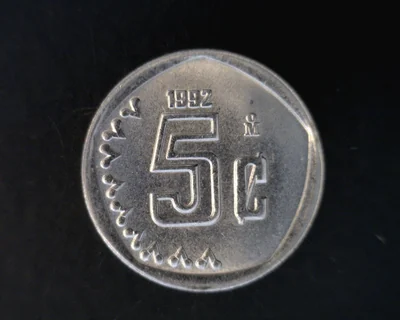
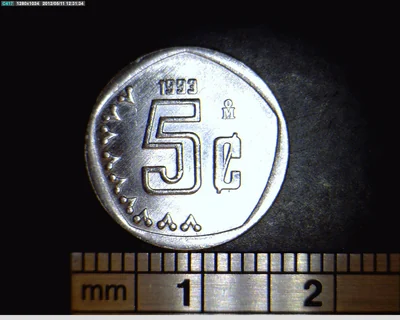
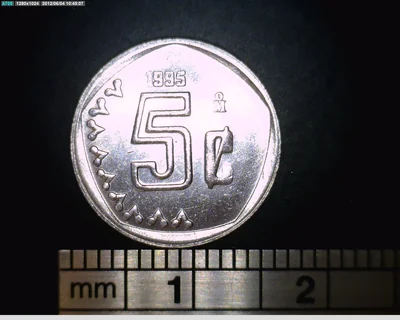
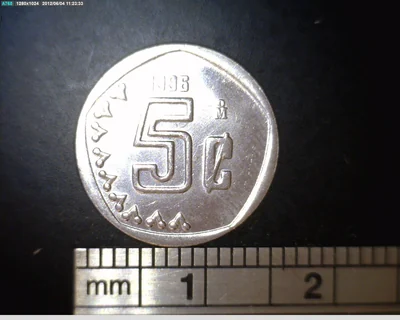
5 centavos Acero inoxidable · 5 Centavos Acero Inoxidable
Frequently asked questions
How much is a 1994 Mexican 5 centavos worth?
A circulated example is worth its face value, effectively a few US cents. A clean uncirculated coin with full luster can sell to a collector for about 1 to 3 US dollars. Certified high grades (MS66 and up) can bring slightly more. It is a common coin, not a rarity.
Is the 1994 5 centavos rare?
No. Millions were struck for circulation, so it is common in worn condition. The only scarcity is condition: because it's stainless steel, most surviving coins are scratched or dull, so finding a pristine, high-grade example is harder than expected.
Where can I sell a 1994 Mexican 5 centavos?
Use a verified coin shop from the Pesoteca dealer directory for an on-the-spot appraisal, or the Pesoteca buy-and-sell forum to reach collectors directly. Photograph the front, back, and edge, and check the price range on this page before selling. Avoid selling to the first offer on social media.
How can I tell if my 1994 5 centavos is genuine?
Weigh it (it should be 1.58 g) and measure the diameter (15.5 mm) with a jewelry scale and calipers. The edge should be plain and smooth. Fakes usually have the wrong weight or diameter, flat relief, or uneven surfaces. For this common coin, counterfeits are rare since there's little profit in faking it.
Conversation
0 comments
Sources
- Ejemplar de la Coleccion Numismatica Banco de Mexico . inv. 18631
- Ejemplar de la Coleccion Numismatica Banco de Mexico . inv. 18628
- Ejemplar de la Coleccion Numismatica Banco de Mexico . inv. 18629
- Ejemplar de la Coleccion Numismatica Banco de Mexico . inv. 18630
- Ejemplar de la Coleccion Numismatica Banco de Mexico . inv. 18632
Images for informational and educational purposes, attributed to their original source. Reference values; the real price depends on the grade, the specific variant and demand.
Loading comments…