
1999 Mexican 50 Centavos: Value & Real Prices
Prices updated: August 2026
Centavos aluminum bronze 1999.
Centavos aluminum bronze 1999.
Design
Banxico
Reverse
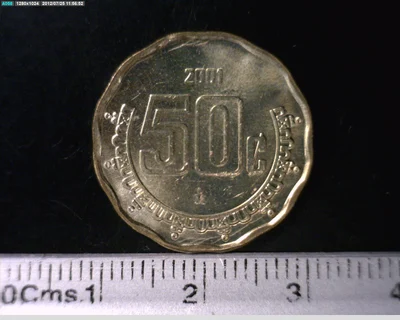
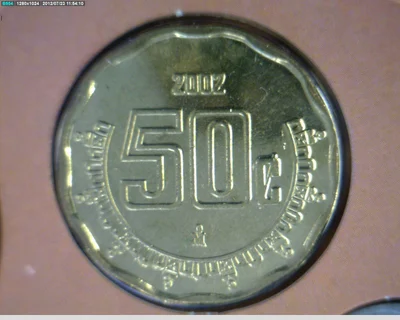
Reverse: the value "50" in large numerals at the center, with the year (1999) and the "Mo" mint mark of the Mexican Mint. At the bottom, a decorative band taken from the Ring of Acceptance of the Sun Stone (Aztec calendar), a motif common to the entire centavos series of this era. KM 549.
Obverse
Obverse with the Mexican National Coat of Arms and the legend "ESTADOS UNIDOS MEXICANOS" per official convention. Struck by the Mexican Mint under Banxico decree.
How much is the 1999 Mexican 50 Centavos: Value & Real Prices worth?
The market value of the 1999 Mexican 50 Centavos: Value & Real Prices is not yet documented with enough data to give a firm range. Weigh and measure your piece, compare it against the specifications, and check the forum for a second opinion.
The real price depends on four factors: the grade of preservation (a circulated piece is worth the low end of the range; an uncirculated one, or one still in its official blister pack, the high end), the finish (satin vs mirror/proof), the rarity within the series based on the mintage, and the metal spot price on the day of the deal when the piece is silver or gold. Check the value-by-grade table above and compare with equivalent pieces before buying or selling.
Where to buy or sell this coin?
Browse the national directory of numismatic shops or the community forum to trade directly with other collectors.
Description
If you found a gold-colored Mexican 50 centavos dated 1999, here is the honest answer: it is worth about face value in circulated condition, and only a couple of dollars at most if it is uncirculated with full original shine. Mexico struck 89,516,000 of them in 1999 alone, so it is common, not rare, and it contains no silver.
This is one of those coins people hope will pay for a vacation. It will not. But knowing exactly what it is, and the one condition where it earns a small premium, is worth two minutes.
What this coin actually is
The 1999 50 centavos belongs to the circulating series launched with Mexico's 1993 currency reform, when the country dropped three zeros from the peso and introduced the "Nuevos Pesos" (New Pesos). "Centavos" are simply Mexican cents: 50 centavos is half a peso.
The metal is aluminum-bronze, an alloy of copper and aluminum that gives the coin its golden tone. No silver, no gold. Here are the exact specs, which also help you spot a fake:
| Specification | Detail |
|---|---|
| Denomination | 50 centavos |
| Year | 1999 |
| Metal | Aluminum-bronze (copper + aluminum) |
| Weight | 4.39 g |
| Diameter | 22 mm |
| Edge | Plain (smooth) |
| Catalog number | KM 549 |
| Mintage (1999) | 89,516,000 |
The front (obverse) shows the National Coat of Arms, the eagle devouring a serpent. The back (reverse) has the large "50" in the center with the year and the Mo mint mark (Casa de Moneda de México, the Mexican Mint). Below the 50 runs a band lifted from the Ring of Acceptance of the Piedra del Sol, the Aztec calendar stone. That pre-Hispanic motif appears across the whole 1990s centavos series.
How much is the 1999 50 centavos worth?
Straight answer by condition:
| Condition | Approximate value (USD) |
|---|---|
| Circulated (worn) | Face value, a few cents |
| Uncirculated (UNC), full luster | Around 1 to 2 dollars |
In worn, circulated grade this coin is worth essentially its face value. It is a genuinely common coin. The only premium shows up in uncirculated (UNC) condition, meaning a piece that never entered circulation and keeps its original mint shine. Even then, dealers ask in the range of one to two dollars, not more. This is not an investment piece.
Because it has no precious metal, there is no melt value to fall back on. Old Mexican silver coins (.720 or .900 fineness) have a floor set by their silver content. This one does not.
Is it rare? No.
Mintage of nearly 90 million in a single year tells you everything. The coin circulated by the millions and still turns up in change, drawers, and coin jars across Mexico. Its appeal is for people completing a date-by-date set of the series, not for anyone chasing scarcity.
Error coins: don't get your hopes up
There is no famous, documented mint error for the 1999 50 centavos that drives up the price of the date. As with any mass-produced circulating coin, individual pieces can turn up off-center or struck from worn dies, but those are one-off cases you would need evaluated individually. No recognized variety makes this year valuable on its own.
How to tell if yours is genuine
Counterfeiting a 50-centavo coin makes no economic sense, so fakes are rare. Still, verify the physical details:
- Weight near 4.39 g
- Diameter of 22 mm
- Plain (smooth) edge
- Golden aluminum-bronze color
- National Coat of Arms on the front, the Aztec calendar band under the 50 on the back
If the weight or diameter is far off, be suspicious. A small kitchen scale and a caliper settle most questions in seconds.
Where to sell it (and whether it's worth the effort)
Because it is so common, this coin sells easily in bulk circulating lots or as single UNC examples, but for very little. If you have a stack, they move as a group rather than one at a time. To buy or sell with a serious numismatist, check the Pesoteca store directory, which lists dealers and collectors by region. If you are trying to complete the run by date, browse the full 50 centavos aluminum-bronze series to see which years you still need.
Curious whether any of the older Mexican coins in your box actually carry silver? Bring your dates and denominations to the Pesoteca forum and we will help you sort the common from the worthwhile.
Historical context
Context of the fifty centavos piece of the year 1999
This fifty centavos coin (KM#549) was minted by the Mexican Mint in 1999, under the presidency of Ernesto Zedillo Ponce de Leon. It is part of the family of circulating pieces in an alloy of bronze and aluminum with nickel that Banxico issued between 1992 and 2009, with 22 mm in diameter and 3.10 g in weight.
The year in Mexico. It is the year of the nine-month strike at the UNAM, begun on April 20, 1999 and resolved only in February 2000 with the eviction by the PFP. It was also the year in which the peso appreciated for the first time in two decades. That year, according to the INPC of INEGI, annual inflation closed at 12.32% and the FIX exchange rate of the Bank of Mexico closed the year at 9.51 pesos per dollar.
How it circulated. In 1999 these pieces circulated with decreasing inflation for the first time in five years. The close at 12.32% marked the step to single digits for the following year. They served for exact payments on intercity buses and as change in shops.
Numismatic note. The 1999 die is the last of Zedillo's term. The matrices were refined to reduce reverse wear, although the design remains identical. The obverse design is the official National Coat of Arms of Banxico and the reverse shows the face value along with the year of minting. Between years the design remains identical and only the engraved date changes, so the visible difference is minimal. The internal die variations, when they exist, are documented in the catalog of the Bank of Mexico.
This piece belongs to the era
Nuevos Pesos y actualidad →Explore all the Mexican coins of this era, their historical context and how they connect to the monetary system of the period.
Value range of this piece
Value range without enough data for this piece.
See the full breakdown by grade (VG, F, VF, EF, AU, MS-60, MS-63, MS-65) for the whole series →
Same denomination, other years
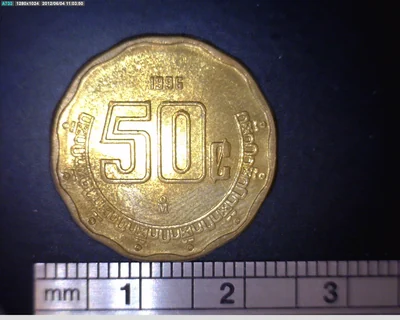
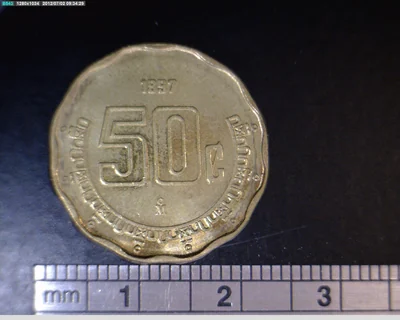
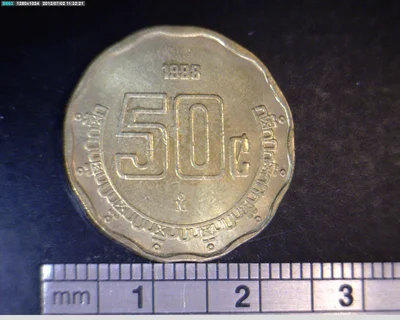
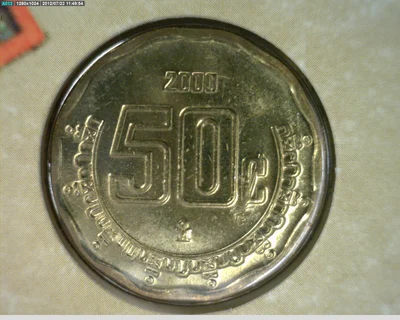
50 centavos Aluminio-bronce · 50 Centavos Bronce Aluminio
Frequently asked questions
How much is the 1999 Mexican 50 centavos worth?
In circulated condition it is worth basically its face value, since it is an extremely common coin. The only premium appears in uncirculated (UNC) grade with original luster, where dealers ask around 1 to 2 dollars. It is not an investment piece.
Is the 1999 50 centavos rare?
No. Mexico's central bank struck 89,516,000 pieces in 1999 alone, so it circulated by the millions and still turns up in change and coin jars. Its interest is for completing a date set, not for scarcity.
Does the 1999 50 centavos contain any silver?
None. It is aluminum-bronze, a copper and aluminum alloy that gives it a golden color. There is no silver or gold, so it has no melt value, unlike older Mexican coins in .720 or .900 silver.
Where can I sell my 1999 50 centavos?
Because it is so common, it sells easily but for very little, usually in bulk lots or as single UNC examples. To deal with a serious buyer, check the Pesoteca store directory at /tiendas, which lists numismatists and collectors by region.
Conversation
0 comments
Loading comments…