
8 Escudos Carlos III 1767: Colonial Gold Value
The 8 Escudos Carlos III 1767: Colonial Gold Value is worth between $51,270 and $86,350 MXN depending on its grade of preservation.
Prices updated: August 2026
Viceroyalty · Mexico City Mint · Assayer MF
Viceroyalty · Mexico City Mint · Assayer MF
The 8 Escudos Carlos III 1767: Colonial Gold Value is worth between $51,270 and $86,350 MXN depending on its grade of preservation.
Prices updated: August 2026
How much is the 8 Escudos Carlos III 1767: Colonial Gold Value worth?
The estimated value of the 8 Escudos Carlos III 1767: Colonial Gold Value ranges from $51,270 (circulated, XF) up to $86,350 (official blister pack), with $73,594 as a reference for an uncirculated (UNC) piece. The estimate is based on the official mintage and the historical behavior of the family.
The real price depends on four factors: the grade of preservation (a circulated piece is worth the low end of the range; an uncirculated one, or one still in its official blister pack, the high end), the finish (satin vs mirror/proof), the rarity within the series based on the mintage, and the metal spot price on the day of the deal when the piece is silver or gold. Check the value-by-grade table above and compare with equivalent pieces before buying or selling.
Where to buy or sell this coin?
Browse the national directory of numismatic shops or the community forum to trade directly with other collectors.
Description
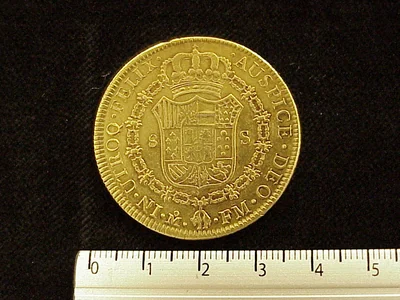
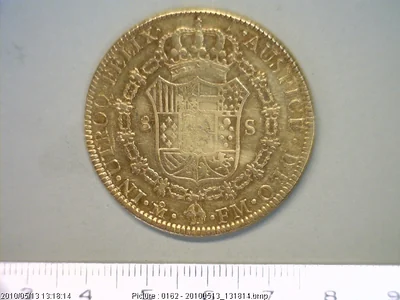
If you inherited or found an 8 Escudos dated 1767 with the bust of Carlos III and the Mexico City mint mark, you are holding one of the most valuable colonial gold coins Spanish America ever struck. In 2026, a genuine piece is worth well into the thousands of US dollars, driven by its gold content first and its 250-year-old rarity second.
This is not a coin that trades for a few dollars. It contains 26.96 grams of 0.875 fine gold (roughly three-quarters of a troy ounce of pure gold), so it has a hard floor tied to the international gold price, and the numismatic premium on top of that is real.
What this coin actually is
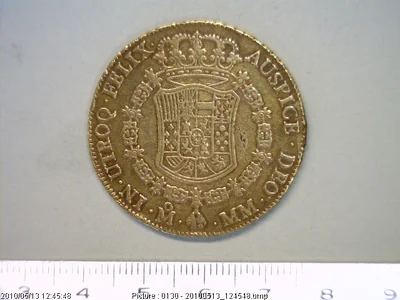
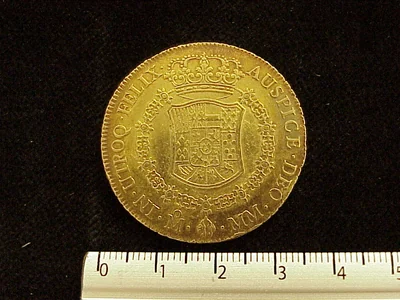
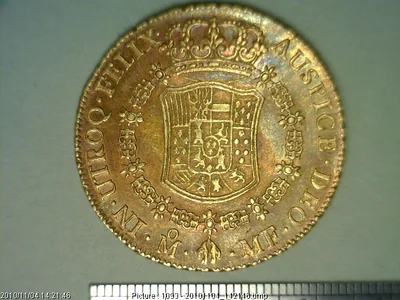
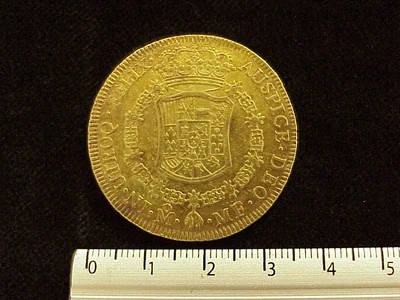
The 8 Escudos was the largest gold denomination struck in colonial Mexico, then called Nueva España (New Spain) under the Spanish Crown. This 1767 issue carries the portrait of King Carlos III and was minted at the Casa de Moneda in Mexico City, the oldest mint in the Americas. Collectors in the English-speaking world often call these large gold coins "doubloons."
Key specifications, which double as your first authenticity check:
- Metal: gold, 0.875 fine (21 karat)
- Weight: 26.96 grams
- Diameter: 36 mm
- Edge: chain pattern (cord edge)
- Mint: Mexico City
- Assayer: MF
- Date: 1767
If your coin does not hit that weight and diameter almost exactly, treat it as suspect until proven otherwise. Gold does not lie: a fake will almost always come in light.
What it is worth in 2026
Value here comes from two layers, and you should think about both.
The metal floor. With about 0.76 troy ounces of pure gold in the coin, the melt value alone runs to well over a thousand US dollars at current gold prices, before any collector premium. That floor moves with the gold market, so it only goes up as gold rises.
The numismatic premium. Genuine, undamaged colonial 8 Escudos of Carlos III trade well above melt. The range is wide and grade drives everything:
| Condition | Typical value (USD) |
|---|---|
| Heavily worn / holed / damaged | melt value to about 1,800 |
| Circulated, clear detail (VF) | 2,000 to 3,500 |
| Lightly circulated (XF/AU) | 3,500 to 6,000 |
| Uncirculated / certified Mint State | 6,000 to well over 10,000 |
Exceptional certified examples of Carlos III 8 Escudos from Mexico City have crossed 10,000 US dollars at Heritage Auctions and Stack's Bowers sales. Common-date circulated pieces settle closer to the low end. The exact 1767 Mexico City mintage is not cleanly documented, which is normal for coins this old, but survivors in high grade are genuinely scarce.
The myth to avoid
Do not assume "250 years old" automatically means "museum fortune." A worn, cleaned, or damaged 8 Escudos is still mostly a lump of colonial gold, valued near its metal content. Cleaning is the big one: scrubbing a coin with polish or acid can cut its collector value in half or worse. If your piece has scratches, a mount hole, or a bright unnatural shine from cleaning, price it toward the bottom of the ranges above.
On the flip side, a truly original, untouched, well-struck example is where the record prices live. The gap between a cleaned coin and an original one can be several thousand US dollars.
How to tell if yours is genuine
- Weigh it. A jeweler's scale should read very close to 26.96 grams. Underweight is the classic tell for a base-metal or low-karat fake.
- Measure it. 36 mm diameter. Modern cast copies are often slightly off.
- Check the edge. The chain / cord edge is hard to fake well. A plain or mushy edge is a warning sign.
- Inspect the strike. Genuine dies leave sharp, consistent lettering. Blurry, soft, or bubbly surfaces suggest a cast copy.
- Get it certified. For a coin in this value range, professional grading by NGC or PCGS settles both authenticity and grade in one step and makes the coin far easier to sell. The certification fee is small next to the coin's value.
Where to sell it (and get paid fairly)
Because this is a high-value gold coin, sell where the buyer can verify it in front of you and where you are not stuck with the first lowball offer.
- A verified numismatic dealer from the Pesoteca directory will appraise it on the spot and can point you to certified grading.
- The Pesoteca buy-and-sell forum puts you in front of collectors who understand what a real 8 Escudos is worth.
- For top-grade certified pieces, an international auction house (Heritage, Stack's Bowers) reaches the buyers who pay the record numbers.
Whatever route you choose, photograph the obverse, reverse, and edge clearly, and note the exact weight. Serious buyers ask for all three. Avoid dumping a coin like this on a general marketplace to the first bidder.
Related pages
This coin belongs to the Colonial Escudos gold series from the Colonial / Viceroyalty era. You can also browse other Mexican 8 Escudos and other coins dated 1767.
Think you have one? Post photos of the obverse, reverse, and edge in the Pesoteca forum and let collectors weigh in before you sell.
Historical context
Eight escudos Carlos III, 1767, Mexico City Mint, assayer MF, Krause KM#155. A historic year: on June 25, 1767, the Pragmatic Sanction was carried out that expelled the Society of Jesus from all Spanish dominions, including New Spain. The operation was coordinated by José de Galvez as visitor general and caused disturbances in several cities of the Bajio, especially Guanajuato and San Luis Potosí, which were harshly suppressed. It was also the year in which Carlos Francisco de Croix assumed the viceroyalty in August, succeeding the Marquis of Cruillas. The ounce weighs 27.06 grams with 0.916 fineness. Produced by mill press with a round planchet, a classic pillar reverse with crowned Pillars of Hercules and PLVS VLTRA. The MF signature of the assayers appears in the field. Krause KM#155 holds for this historically dense year.
This piece belongs to the era
Colonial / Virreinato →Explore all the Mexican coins of this era, their historical context and how they connect to the monetary system of the period.
Value range of this piece
Market estimate: $51,270 - $86,350 MXN depending on the grade of preservation (typical range between a circulated and an uncirculated piece).
See the full breakdown by grade (VG, F, VF, EF, AU, MS-60, MS-63, MS-65) for the whole series →
Same denomination, other years
8 escudos Oro 0.875 (21k) · Escudos Coloniales (oro)
Frequently asked questions
How much is an 8 Escudos Carlos III 1767 worth?
It depends heavily on grade and authenticity. The melt value alone (about 0.76 oz of pure gold) is over a thousand US dollars. A genuine circulated example runs roughly 2,000 to 3,500 USD, and certified Mint State pieces reach 6,000 to over 10,000 USD at major auctions. Get it professionally graded before selling a coin in this range.
Is the 8 Escudos Carlos III 1767 rare?
The exact Mexico City mintage for 1767 is not cleanly documented, which is common for coins this old. What matters is that high-grade survivors are genuinely scarce, since most circulated heavily or were melted. Worn examples are more available; original, uncleaned Mint State pieces are the truly rare and valuable ones.
How can I tell if my 8 Escudos Carlos III 1767 is genuine?
Start with weight and size: it should read very close to 26.96 grams and 36 mm. Check for the chain (cord) edge and sharp, consistent lettering. Fakes usually come in underweight or in lower-karat gold. For anything you plan to sell above a couple thousand US dollars, get it certified by NGC or PCGS, which confirms both authenticity and grade.
Where can I sell an 8 Escudos Carlos III 1767?
Sell through a verified dealer from the Pesoteca directory, who can appraise and verify it in person, or the Pesoteca buy-and-sell forum where collectors know its true value. For top certified examples, international auction houses like Heritage or Stack's Bowers reach buyers who pay record prices. Always photograph the obverse, reverse, and edge and record the exact weight before selling.
Conversation
0 comments
Sources
Images for informational and educational purposes, attributed to their original source. Reference values; the real price depends on the grade, the specific variant and demand.
Loading comments…