
8 Escudos Gold Coin (1736), Felipe V of Mexico: Value & Prices
The 8 Escudos Gold Coin , Felipe V of Mexico: Value & Prices is worth between $51,308 and $86,414 MXN depending on its grade of preservation.
Prices updated: August 2026
The 8 Escudos Gold Coin , Felipe V of Mexico: Value & Prices is worth between $51,308 and $86,414 MXN depending on its grade of preservation.
Prices updated: August 2026
How much is the 8 Escudos Gold Coin (1736), Felipe V of Mexico: Value & Prices worth?
The estimated value of the 8 Escudos Gold Coin (1736), Felipe V of Mexico: Value & Prices ranges from $51,308 (circulated, XF) up to $86,414 (official blister pack), with $73,648 as a reference for an uncirculated (UNC) piece. The estimate is based on the official mintage and the historical behavior of the family.
The real price depends on four factors: the grade of preservation (a circulated piece is worth the low end of the range; an uncirculated one, or one still in its official blister pack, the high end), the finish (satin vs mirror/proof), the rarity within the series based on the mintage, and the metal spot price on the day of the deal when the piece is silver or gold. Check the value-by-grade table above and compare with equivalent pieces before buying or selling.
Where to buy or sell this coin?
Browse the national directory of numismatic shops or the community forum to trade directly with other collectors.
Description
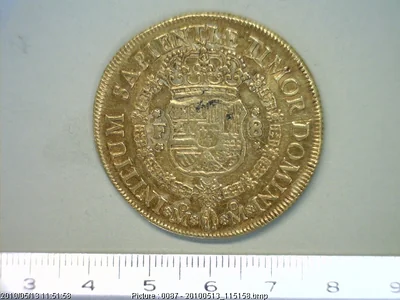
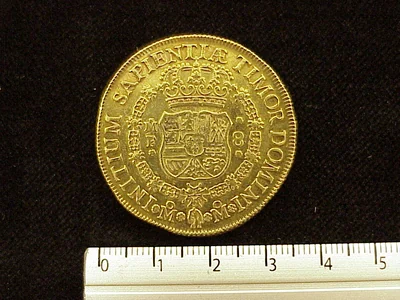
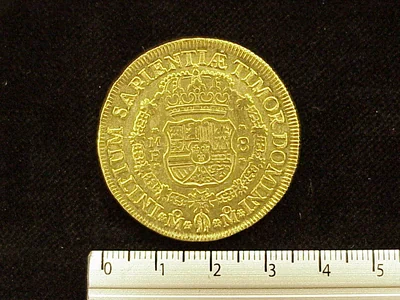
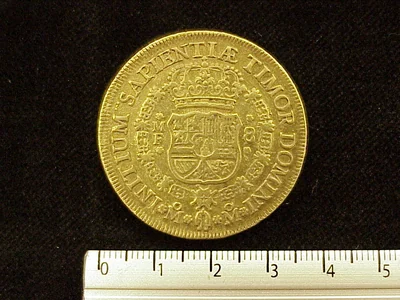
If you inherited or found a 1736 gold coin the size of a US silver dollar with a Spanish king on it, you may be holding a Mexican 8 escudos, the coin English speakers call a doubloon. This is not a few-dollar curiosity. Even in worn condition, a genuine one is worth several thousand US dollars because of its gold content alone, and rare, high-grade examples have sold for well over 20,000 dollars.
In 2026, the 8 escudos of Felipe V remains one of the most sought-after colonial gold coins in the market. Here is exactly what it is, what drives its value, and how to sell it without getting shortchanged.
What you actually have
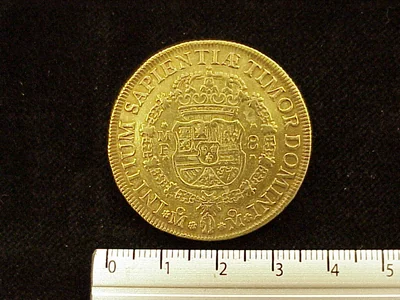
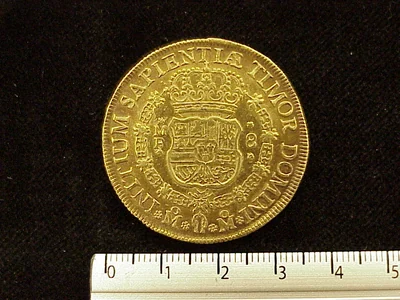
The 8 escudos was the largest gold denomination in the Spanish colonial system, struck at the Mexico City mint (the Casa de Moneda de México), which was the main silver and gold producer of the Spanish Empire. Your 1736 piece was minted under Felipe V, in what collectors call his second period.
Key facts to verify against your coin:
- Metal: gold
- Weight: 26.98 grams
- Diameter: 37 mm
- Edge: diagonally reeded
- Catalog reference: KM#148
- Assayer initials: MF (the mint official who certified the metal's purity)
That MF mark, the mint mark, and the date are the first things a specialist looks at. They also determine value, because some assayer and date combinations are far scarcer than others.
What it is worth in 2026
Value rests on three things: gold content, condition (grade), and whether it is genuine. Because it contains close to 27 grams of gold, this coin has a hard floor at its melt value, which sits in the low thousands of US dollars at current gold prices. No genuine 8 escudos trades below that.
Above that floor, condition drives everything. A heavily worn but authentic example typically brings a few thousand dollars over melt. A sharp, problem-free coin with clear detail on the king's portrait and the shield can bring several times more. Certified high-grade Felipe V 8 escudos have realized well into five figures at major US auctions.
| Grade / condition | Approximate value (USD) |
|---|---|
| Damaged, mount-removed, or cleaned | Melt value, roughly 1,500 to 2,500 |
| Worn but genuine and original | 3,000 to 6,000 |
| Sharp detail, lightly circulated | 7,000 to 15,000 |
| Certified high grade (NGC/PCGS) | 15,000 to 25,000-plus |
These are market ranges, not a quote for your specific coin. Date, assayer, and eye appeal move a single example up or down within them. To pin down a firm figure you need the coin in hand and, ideally, third-party certification.
Why grade matters more than age
Many people assume an old coin is automatically worth a fortune. Age alone means little. What a buyer pays for is the combination of gold content, genuine rarity, and preservation. Two 1736 8 escudos can differ by a factor of five or more purely on condition. A coin that spent years in a piece of jewelry, has solder marks, or was harshly cleaned loses much of its numismatic premium and falls back toward melt.
How to tell if yours is genuine
Colonial gold is heavily counterfeited, so verify before you celebrate or sell.
- Weigh it. Use a jewelry scale. A genuine coin should be very close to 26.98 grams. A significant miss is a red flag.
- Measure it. The diameter should be about 37 mm.
- Check the edge. It should show diagonal reeding, not a smooth or plain edge.
- Study the engraving. Look at the portrait style, the mint mark, and the MF assayer initials. Fakes often botch the lettering and the crest details.
- Be suspicious of a bargain. Any offer well below the coin's gold value almost certainly means the seller knows something you do not.
For a coin at this value level, professional authentication and grading by NGC or PCGS is worth the cost. A certified coin sells faster and for more, because the buyer is not gambling on authenticity.
Errors and varieties
Genuine minting errors (off-center strikes, die rotation, doubled strikes) can raise value if a specialist confirms them. Be cautious: most "errors" shared online are post-mint damage such as scratches, dents, and corrosion, not factory errors. If you think you have a real one, post clear photos for review before assuming a premium.
Where to sell
Because this is a high-value precious-metal coin, sell where the buyer can inspect and weigh it in front of you, and where you can verify their offer against the ranges above.
- A verified numismatic dealer from the Pesoteca directory can appraise it on the spot.
- The Pesoteca buy-and-sell forum puts you in front of collectors who understand colonial gold.
- For the strongest price, consider consigning a certified example to a major auction house that handles world gold.
Photograph the obverse, reverse, and edge before you talk to anyone. Never accept a lowball offer from the first buyer on social media, and never hand the coin over before payment is confirmed.
Think you have a genuine 1736 8 escudos, or want a second opinion on the grade? Post your photos in the Pesoteca forum and let the community weigh in before you sell.
Historical context
Eight escudos Philip V second period, 1736, Mexico City Mint. The year the great matlazahuatl epidemic broke out in New Spain, an exanthematic typhus that claimed hundreds of thousands of lives through 1739, especially among the indigenous population of the Bajio and central Mexico. Viceroy Vizarron y Eguiarreta faced the crisis from his dual civil and ecclesiastical authority. The onza weighs 27.06 grams with 0.916 fineness. Milled production with a round planchet under the pillar system introduced in 1732. The reverse shows the crowned Pillars of Hercules over the sea and the bands with PLVS VLTRA. In Spain, Philip V was in his second period since 1724, after the brief reign of his son Louis I. The mint's technical standardization already operated with precision: prefabricated round planchet, press striking on the mill, treated edge. 1736 pieces are collectible for the documented epidemic context and for belonging to the first five-year block of the Mexican pillar coinage, still without the die varieties Krause would detail for later years of the same reign.
This piece belongs to the era
Colonial / Virreinato →Explore all the Mexican coins of this era, their historical context and how they connect to the monetary system of the period.
Value range of this piece
Market estimate: $51,308 - $86,414 MXN depending on the grade of preservation (typical range between a circulated and an uncirculated piece).
See the full breakdown by grade (VG, F, VF, EF, AU, MS-60, MS-63, MS-65) for the whole series →
Same denomination, other years
8 escudos Oro 0.875 (21k) · 8 Escudos Felipe V Segunda Epoca
Frequently asked questions
How much is a 1736 Felipe V 8 escudos gold coin worth?
A genuine one is worth at least its gold value, roughly 1,500 to 2,500 USD at current prices, even if damaged. Worn but original examples bring 3,000 to 6,000 USD, sharp coins 7,000 to 15,000 USD, and certified high-grade pieces 15,000 to 25,000-plus USD. Grade, date, and assayer determine where yours falls.
Is the 1736 8 escudos rare?
It is a scarce and desirable colonial gold coin, though not unique. Specific date and assayer (MF) combinations vary in rarity, and high-grade survivors are genuinely hard to find. Because it is gold, even common-grade examples never fall below melt value, which keeps every genuine piece in the thousands of dollars.
Where can I sell a 1736 8 escudos coin?
Sell through a [verified numismatic dealer in the Pesoteca directory](/tiendas), who can weigh and appraise it in person, or the [Pesoteca buy-and-sell forum](/foro/compra-venta) among collectors. For a certified high-grade coin, a major world-gold auction may bring the best price. Photograph both sides and the edge first, and confirm payment before releasing the coin.
How do I tell if my 1736 8 escudos is genuine?
Weigh it (should be about 26.98 grams) and measure it (about 37 mm) with a jewelry scale and caliper. Check for a diagonally reeded edge and examine the portrait, mint mark, and MF assayer initials, which fakes often get wrong. Colonial gold is heavily counterfeited, so for a coin this valuable, get it authenticated by NGC or PCGS.
Conversation
0 comments
Loading comments…