
8 Escudos Fernando VII 1809: Gold Value & Prices
The 8 Escudos Fernando VII 1809: Gold Value & Prices is worth between $51,365 and $86,510 MXN depending on its grade of preservation.
Prices updated: August 2026
First Type
First Type
The 8 Escudos Fernando VII 1809: Gold Value & Prices is worth between $51,365 and $86,510 MXN depending on its grade of preservation.
Prices updated: August 2026
How much is the 8 Escudos Fernando VII 1809: Gold Value & Prices worth?
The estimated value of the 8 Escudos Fernando VII 1809: Gold Value & Prices ranges from $51,365 (circulated, XF) up to $86,510 (official blister pack), with $73,730 as a reference for an uncirculated (UNC) piece. The estimate is based on the official mintage and the historical behavior of the family.
The real price depends on four factors: the grade of preservation (a circulated piece is worth the low end of the range; an uncirculated one, or one still in its official blister pack, the high end), the finish (satin vs mirror/proof), the rarity within the series based on the mintage, and the metal spot price on the day of the deal when the piece is silver or gold. Check the value-by-grade table above and compare with equivalent pieces before buying or selling.
Where to buy or sell this coin?
Browse the national directory of numismatic shops or the community forum to trade directly with other collectors.
Description
If you inherited an 1809 gold coin with a portrait bust and the name Fernando VII, you are holding real money. This is a colonial 8 Escudos struck in gold at the Mexico City mint. Even in worn condition it carries a floor value of more than 1,600 USD from its gold content alone, and choice examples sell for several thousand dollars at auction in 2026.
What you actually have
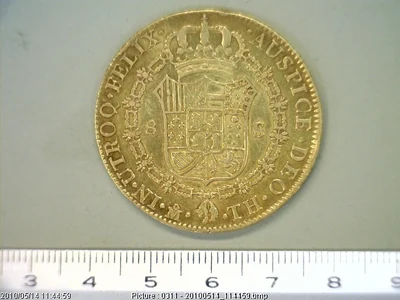
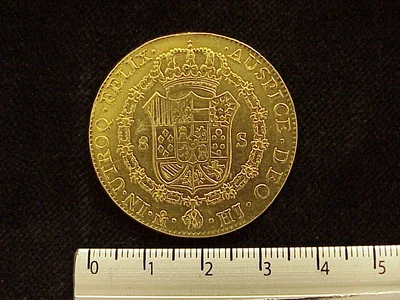
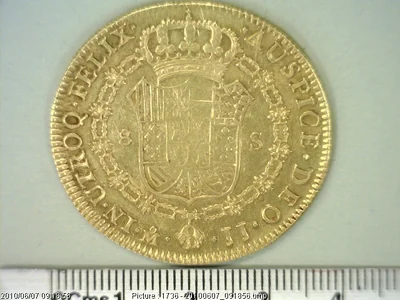
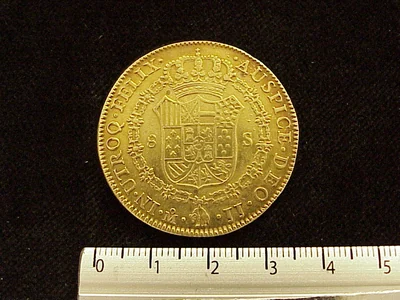
The 8 Escudos was the largest gold denomination of the Spanish colonial system, popularly called an "onza" (Spanish for ounce). This one dates to 1809, during the reign of Fernando VII of Spain, and was minted in Mexico City, the main silver and gold producer of the Spanish Empire at the time.
The letters HJ on the coin are the assayer's initials, the official who certified the fineness of the metal. That is a normal part of the design, not a defect or a rare variety.
Technical specs (verify yours against these)
| Feature | Detail |
|---|---|
| Metal | Gold |
| Weight | 27.01 g |
| Diameter | 37 mm |
| Edge | Diagonally reeded |
| Catalog reference | KM#160 |
| Mint | Mexico City |
| Assayer | HJ |
At 27.01 grams of gold at roughly 0.875 fineness, the coin contains close to three-quarters of a troy ounce of pure gold. That is why it always has a hard floor: its melt value. No matter how worn, an authentic example is worth what the gold is worth.
What it's worth in USD
Think of the value in two layers.
Floor (melt value). With about 0.76 troy ounces of gold inside, the metal alone is worth well over 1,600 USD at current gold prices, and that number rises with the gold market. A heavily worn, damaged, or cleaned example trades close to this floor.
Collector premium. Above melt, condition and eye appeal decide everything. A solid, original example with clear detail can bring a meaningful premium over gold. Higher-grade certified pieces (graded by NGC or PCGS) reach into the several-thousand-dollar range, depending on strike quality and surfaces.
| Condition | Approximate value in USD |
|---|---|
| Worn / damaged / cleaned | Melt value, roughly 1,600 to 1,800 |
| Circulated, honest wear | Melt plus a modest premium |
| High grade, certified | Several thousand |
We give ranges rather than a single fixed price because gold coins of this type move with two things at once: the daily gold price and the specific grade of your coin. Do not trust any single "exact" figure you see online for a coin like this.
The myth to avoid
Being over 200 years old does not automatically make this a museum piece worth a fortune. Colonial 8 Escudos were struck in real quantity, and many survive. Age is not the driver here. Gold content sets the floor, and grade and originality set the ceiling. A cleaned or damaged coin is worth its metal, period.
The bigger risk is the opposite: this is one of the most heavily counterfeited coin types in the world, precisely because it is gold and valuable. Treat any suspiciously cheap offer as fake until proven otherwise.
How to check if yours is genuine
- Weigh it. Use a jewelry scale. It should read very close to 27.01 g. A coin that is light is a red flag.
- Measure it. Diameter should be about 37 mm.
- Check the edge. Genuine pieces have a diagonally reeded edge. Cast fakes often have a soft, mushy, or seamed edge.
- Study the engraving. Compare the portrait style, the mint mark, and the HJ assayer letters against verified references. Counterfeits often get the lettering or the bust proportions wrong.
- Get it certified. For a coin at this value, professional grading by NGC or PCGS is worth it. It confirms authenticity, assigns a grade, and makes selling far easier.
Be skeptical of any deal priced below the coin's gold value. That is the classic signature of a fake.
Where to sell it
Sell where the buyer will show the coin, weigh it in front of you, and let you verify before money changes hands.
- A verified numismatic dealer from the Pesoteca directory, searchable by city, will appraise it on the spot without middleman markups.
- The Pesoteca buy-and-sell forum connects you directly with collectors.
- For a high-grade piece, a major international auction house (Heritage, Stack's Bowers) is where certified colonial gold reaches top prices.
Before you sell, photograph the obverse, reverse, and edge clearly, and check the value range above against the current gold price. Do not dump it to the first offer on social media.
Have the coin in hand? Post clear photos of both sides on the Pesoteca forum and let collectors help you pin down the grade before you decide what to do with it.
Historical context
Eight escudos, Fernando VII, 1809, Mexico City mint. The record lists the first type. A full year under the Spanish War of Independence against the Napoleonic occupation. In Mexico, Francisco Javier de Lizana y Beaumont governed, archbishop and viceroy since July 1809, succeeding Garibay. His administration sought to calm creole sentiment but was interpreted as weak by the peninsular elite. The idealized armored bust of Fernando VII was still used because the king was a prisoner in France and no updated royal portrait was available at the capital mint. The ounce weighs 27.06 grams with a fineness of 0.875. Produced by mill press with a round planchet. In New Spain the first conspiracies that would lead to the Grito de Dolores a year later were beginning, such as the Valladolid conspiracy led by José Mariano Michelena and discovered that same year. The piece is a numismatic testimony of the last year of the stable viceregal order before the armed insurgency. Pieces from 1809 are collectible for documenting the year of greatest political tension in New Spain before the independence outbreak of September 1810.
This piece belongs to the era
Colonial / Virreinato →Explore all the Mexican coins of this era, their historical context and how they connect to the monetary system of the period.
Value range of this piece
Market estimate: $51,365 - $86,510 MXN depending on the grade of preservation (typical range between a circulated and an uncirculated piece).
See the full breakdown by grade (VG, F, VF, EF, AU, MS-60, MS-63, MS-65) for the whole series →
Same denomination, other years
8 escudos Oro 0.875 (21k) · 8 Escudos Fernando VII
Frequently asked questions
How much is the 1809 8 Escudos Fernando VII worth?
Its floor is the gold value, roughly 1,600 to 1,800 USD, because it holds about 0.76 troy ounces of gold. Circulated examples with honest wear bring a modest premium over melt, while high-grade certified pieces reach several thousand USD. Condition and the current gold price both matter.
Is the 1809 8 Escudos rare?
Not especially. Colonial 8 Escudos were struck in quantity and many survive, so age alone does not make it a fortune. Value comes from gold content (which sets a hard floor) and from grade and originality. A cleaned or damaged coin is worth mostly its metal.
Where can I sell my 1809 8 Escudos coin?
Use a [verified dealer from the Pesoteca directory](/tiendas) for an on-the-spot appraisal, or the [Pesoteca buy-and-sell forum](/foro/compra-venta) to reach collectors. For high-grade pieces, major auction houses like Heritage or Stack's Bowers get the best results. Always photograph both sides and the edge first.
How do I tell if my 8 Escudos is genuine?
Weigh it (should be close to 27.01 g) and measure it (about 37 mm) with a jewelry scale and calipers. Check for a diagonally reeded edge and compare the bust, mint mark, and HJ assayer letters to verified references. This type is heavily counterfeited, so professional grading by NGC or PCGS is strongly recommended.
Conversation
0 comments
Loading comments…