
1811 Fernando VII 8 Escudos Gold Coin: Value & How to Sell
The 1811 Fernando VII 8 Escudos Gold Coin: Value & How to Sell is worth between $51,327 and $86,446 MXN depending on its grade of preservation.
Prices updated: August 2026
First type; armored bust.
First type; armored bust.
The 1811 Fernando VII 8 Escudos Gold Coin: Value & How to Sell is worth between $51,327 and $86,446 MXN depending on its grade of preservation.
Prices updated: August 2026
How much is the 1811 Fernando VII 8 Escudos Gold Coin: Value & How to Sell worth?
The estimated value of the 1811 Fernando VII 8 Escudos Gold Coin: Value & How to Sell ranges from $51,327 (circulated, XF) up to $86,446 (official blister pack), with $73,675 as a reference for an uncirculated (UNC) piece. The estimate is based on the official mintage and the historical behavior of the family.
The real price depends on four factors: the grade of preservation (a circulated piece is worth the low end of the range; an uncirculated one, or one still in its official blister pack, the high end), the finish (satin vs mirror/proof), the rarity within the series based on the mintage, and the metal spot price on the day of the deal when the piece is silver or gold. Check the value-by-grade table above and compare with equivalent pieces before buying or selling.
Where to buy or sell this coin?
Browse the national directory of numismatic shops or the community forum to trade directly with other collectors.
Description
If you inherited an 1811 Fernando VII 8 Escudos, you are holding real gold, not a common pocket coin. This is the largest gold denomination of colonial Mexico, nicknamed the onza (ounce). Even a worn example is worth at least its metal, roughly 2,000 USD at current gold prices, and a sharp, high-grade piece can bring 10,000 USD or more at auction.
What you actually have
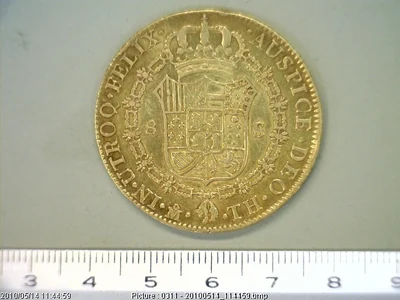
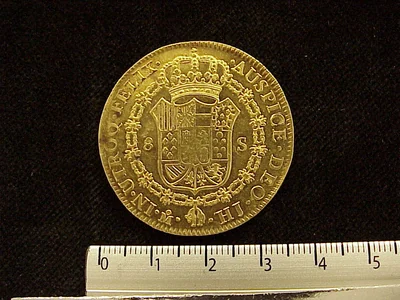
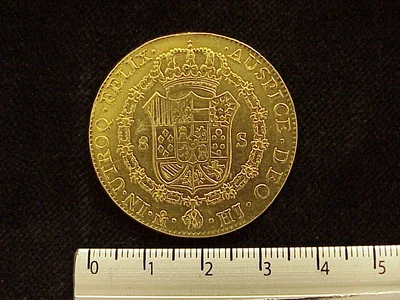
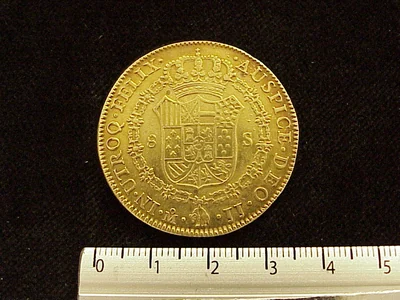
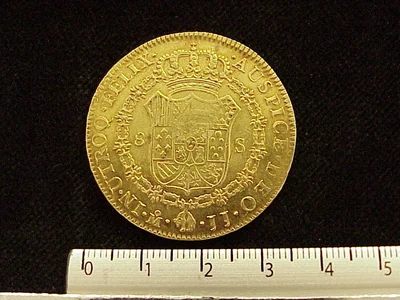
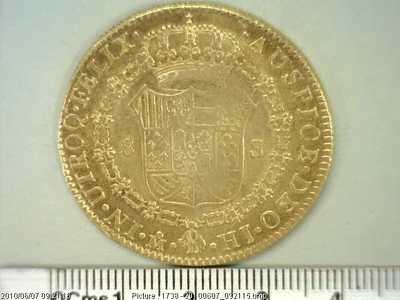
The 8 Escudos was the top gold coin of the Spanish colonial system in Mexico. This one was struck at the Casa de Moneda de México (the Mexico City Mint), then the busiest mint in Spain's American empire. It carries the bust of King Fernando VII on the front and the crowned Spanish royal shield, ringed by the Order of the Golden Fleece (Toisón de Oro), on the back.
Here are the hard specs. Match your coin against these before anything else:
| Feature | Specification |
|---|---|
| Denomination | 8 Escudos (gold onza) |
| Year | 1811 |
| Mint | Mexico City (México) |
| Weight | 26.99 grams |
| Diameter | 37.4 mm |
| Edge | Diagonal reeded |
| Metal | Gold |
| Catalog | Krause (KM#) Fernando VII gold series, Mexico mint |
A quick note on the portrait: Fernando VII was a prisoner of Napoleon from 1808, so mints had no updated official likeness. The bust you see is an "imaginary" or conventional portrait, engraved from older models. That is normal for this period and not a defect.
Is it rare, and what is it worth?
Don't confuse age with rarity. Plenty of colonial gold survives because gold gets hoarded, not spent. What drives the price of an 8 Escudos is three things: gold content, grade (state of preservation), and eye appeal on the bust and shield.
The floor is the gold. At 26.99 grams of gold (colonial 8 Escudos are struck in .875 to .901 fine gold depending on the standard, holding close to 0.76 troy ounces of pure gold), this coin has a hard bullion value that moves with the gold market. As of recent gold prices that is roughly 2,000 USD in melt, and no genuine example is worth less than that.
Grade sets the ceiling. A heavily worn coin trades near melt. A coin with a full, crisp bust and shield, minimal wear on the high points, and no damage can sell for several thousand dollars. Certified Mint State examples of Mexico City Fernando VII 8 Escudos have crossed 10,000 USD at major auction houses, though condition and date variety matter a great deal.
Honest range for a genuine 1811 Mexico 8 Escudos: from roughly 2,000 USD (worn, melt-driven) up to 10,000 USD or more (high grade, certified). Get the exact figure by having it graded, since the difference between a good coin and a great one here is thousands of dollars.
How to tell if yours is genuine
Colonial gold is heavily counterfeited, so verify before you get excited or before you pay anyone.
- Weigh it. Use a jewelry scale. It should be very close to 26.99 grams. Underweight is a red flag.
- Measure it. Diameter should be 37.4 mm on a caliper.
- Check the edge. Genuine pieces have a diagonal reeded edge, not smooth and not straight-cut.
- Study the engraving. Look at the style of the bust, the mint mark, and the assayer's initials. Fakes often get these details wrong. Compare against verified reference photos.
- Be suspicious of any deal well below melt value. Nobody sells real gold cheap by accident.
If anything looks off, do not buy or sell until a professional confirms it. For a coin at this value, third-party grading and authentication (NGC or PCGS) is worth the fee because it settles both authenticity and grade in one step.
About "error" coins
Genuine mint errors (off-center strikes, die rotation, double strikes, known varieties) can multiply the value if they are verified. But most "errors" people spot on social media are post-mint damage: dings, scratches, or corrosion, not factory mistakes. If you think you have a real error, post clear photos in the Pesoteca forum and let the community review it before you assume it is worth more.
Where to sell it
Sell smart, because this is a precious-metal coin and buyers will lowball if you look unsure.
- A verified numismatic shop from the Pesoteca dealer directory will appraise it on the spot and let you see the weighing.
- The Pesoteca buy-and-sell forum connects you directly with collectors, which usually beats a quick dealer flip.
- Photograph the front, back, and edge before you talk to anyone, and know the price range on this page.
Avoid dumping it to the first bidder on Facebook, and never sell for less than the gold value.
Got an 1811 8 Escudos in a family collection? Post your photos and weight in the Pesoteca forum and we'll help you pin down the grade and a realistic number.
Historical context
Eight escudos, Fernando VII, 1811, Mexico Mint. The listing describes the first type with armored bust. A year of the first phase of the War of Independence: in January Hidalgo lost the Battle of Puente de Calderón against Felix María Calleja and was captured in March at Acatita de Baján. He was executed on July 30 in Chihuahua. The resistance continued under José María Morelos in the south and Ignacio López Rayón in the center. In Mexico, Venegas remained viceroy and organized the royalist counteroffensive. The ounce weighs 27.06 grams with fineness 0.875. It was still struck with the imaginary bust of Fernando VII owing to the absence of a current official portrait. The assayer's mark appears in the reverse field. Pieces from this year carry a symbolic charge: they are royal coin struck while the war that would decide the political future of the viceroyalty was being fought in that very territory. The capital mint's gold production was not interrupted despite the internal conflict, a sign of the royalist military control over Mexico City throughout the first phase of the war.
This piece belongs to the era
Colonial / Virreinato →Explore all the Mexican coins of this era, their historical context and how they connect to the monetary system of the period.
Value range of this piece
Market estimate: $51,327 - $86,446 MXN depending on the grade of preservation (typical range between a circulated and an uncirculated piece).
See the full breakdown by grade (VG, F, VF, EF, AU, MS-60, MS-63, MS-65) for the whole series →
Same denomination, other years
8 escudos Oro 0.875 (21k) · 8 Escudos Fernando VII
Frequently asked questions
How much is an 1811 Fernando VII 8 Escudos worth?
It ranges from roughly 2,000 USD for a worn coin (driven by its 26.99 grams of gold) up to 10,000 USD or more for a high-grade, certified example. Grade and eye appeal on the bust and shield decide where in that range yours falls, so getting it professionally graded is the fastest way to a firm number.
Is the 1811 8 Escudos rare?
Age alone doesn't make it rare. Colonial gold survives well because it was hoarded rather than spent. What makes a specific 8 Escudos valuable is grade, not just year. Common-grade pieces trade near melt; genuinely high-grade certified examples are scarce and command strong premiums at auction.
How can I tell if my 1811 8 Escudos is genuine?
Weigh it (should be near 26.99 grams) and measure it (37.4 mm) with a jewelry scale and caliper, then compare to the specs above. Check for the diagonal reeded edge and study the bust, mint mark, and assayer initials, since colonial gold is heavily faked. Any offer well below melt value is a warning sign. For final proof, use NGC or PCGS certification.
Where can I sell an 1811 Fernando VII 8 Escudos?
The safest options are a verified shop from the [Pesoteca dealer directory](/tiendas), which appraises it in person, or the [Pesoteca buy-and-sell forum](/foro/compra-venta) among collectors. Photograph the front, back, and edge, know the price range on this page, and never sell below the coin's gold value or to the first anonymous bidder online.
Conversation
0 comments
Loading comments…