
8 Escudos Fernando VII 1810: What This Gold Coin Is Worth
The 8 Escudos Fernando VII 1810: What This Gold Coin Is Worth is worth between $51,365 and $86,510 MXN depending on its grade of preservation.
Prices updated: August 2026
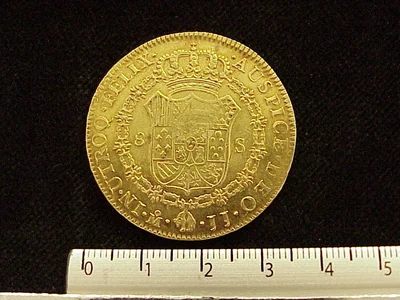
First type; armored bust; double punch "8"
First type; armored bust; double punch "8"
The 8 Escudos Fernando VII 1810: What This Gold Coin Is Worth is worth between $51,365 and $86,510 MXN depending on its grade of preservation.
Prices updated: August 2026
How much is the 8 Escudos Fernando VII 1810: What This Gold Coin Is Worth worth?
The estimated value of the 8 Escudos Fernando VII 1810: What This Gold Coin Is Worth ranges from $51,365 (circulated, XF) up to $86,510 (official blister pack), with $73,730 as a reference for an uncirculated (UNC) piece. The estimate is based on the official mintage and the historical behavior of the family.
The real price depends on four factors: the grade of preservation (a circulated piece is worth the low end of the range; an uncirculated one, or one still in its official blister pack, the high end), the finish (satin vs mirror/proof), the rarity within the series based on the mintage, and the metal spot price on the day of the deal when the piece is silver or gold. Check the value-by-grade table above and compare with equivalent pieces before buying or selling.
Where to buy or sell this coin?
Browse the national directory of numismatic shops or the community forum to trade directly with other collectors.
Description
If you inherited an 1810 Mexican 8 Escudos with the bust of Fernando VII, here is the fast answer: this is a large gold coin, so it is never worth just face value. It carries about 24.4 grams of pure gold, which sets a hard floor in the low thousands of US dollars at any gold price, and genuine, well-preserved examples sell for more than melt. In 2026, a typical circulated piece trades in the roughly 2,000 to 4,000 USD range, with sharp, high-grade examples going higher.
What you actually have
The 8 Escudos was the highest-denomination coin of the Spanish colonial system, popularly called an "onza" (Spanish for "ounce"). Yours was struck at the Mexico City Mint (the Casa de Moneda de México) in 1810, while Mexico was still a Spanish colony and its mint was the main gold and silver supplier of the Spanish Empire.
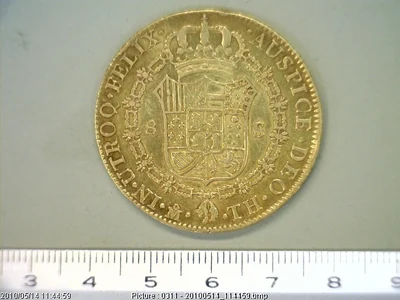
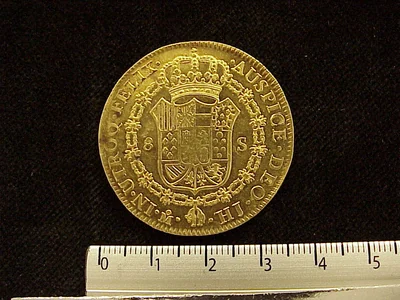
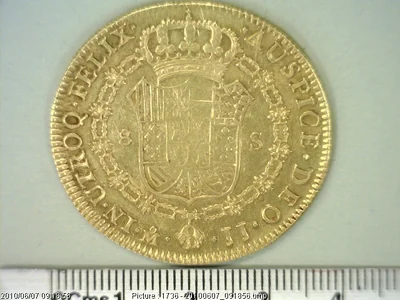
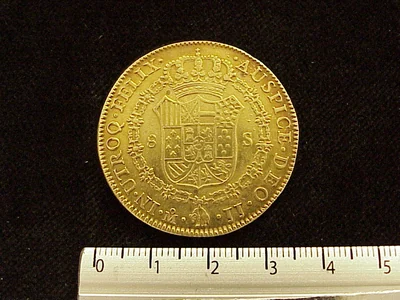
The design shows Fernando VII, king of Spain. You should also see the letters HJ on the coin: those are the assayer's initials, the mint official who certified the metal's purity. The mint mark for Mexico City is an M with a small o above it.
Specifications (verify yours against these)
| Detail | Value |
|---|---|
| Metal | Gold, .875 fineness |
| Total weight | 27.01 g |
| Pure gold content | about 24.4 g (roughly 0.784 troy oz) |
| Diameter | 37 mm |
| Edge | diagonally reeded |
| Catalog reference | KM#160 |
| Mint | Mexico City |
| Assayer | HJ |
Because it is a precious-metal coin, its weight and diameter are your first authentication check. Put it on a jewelry scale and measure the diameter with a caliper. A genuine piece should be very close to 27.01 g and 37 mm. A coin that is light, oversized, or magnetic is a red flag.
What drives the value
Three things set the price, in this order:
- Gold content (the floor). With roughly three-quarters of a troy ounce of pure gold, the coin can never be worth less than its melt value. That alone keeps it in the low thousands of USD.
- Condition (grade). A worn, cleaned, or scratched coin sells close to melt. A sharp piece with original detail and no cleaning commands a real premium over gold value.
- Authenticity and eye appeal. Colonial gold is heavily counterfeited. A coin certified by NGC or PCGS sells faster and higher than a raw (uncertified) one, because the buyer does not have to gamble.
Honest note on the year: 1810 is the year Mexico's War of Independence began, and buyers do attach some historical interest to coins from that date. That interest helps demand, but it does not turn an ordinary example into a museum piece. The bulk of the value is still the gold plus the grade.
What it is not
This is not a unique rarity worth a fortune, despite what some listings imply. The Mexico City Mint produced 8 Escudos across many years, and Fernando VII pieces exist in reasonable numbers. If a seller tells you an average circulated example is worth five figures, be skeptical and check the grade first. Real record prices for colonial 8 Escudos are reserved for the finest-known, certified, high-grade coins, not the typical inherited piece.
How to check what yours is worth
- Weigh and measure it. Compare to the table above. This is your first counterfeit screen.
- Look at the details. Study the assayer letters (HJ), the mint mark, and the sharpness of the portrait and shield. Fakes often have soft, mushy, or slightly wrong lettering.
- Do not clean it. Cleaning gold coins removes original surface and lowers value. Leave it exactly as you found it.
- Get it graded if it looks genuine and reasonably sharp. NGC or PCGS certification confirms authenticity and grade, which is what serious buyers pay for.
- Photograph the obverse, reverse, and edge in good light before you talk to any buyer.
Where to sell it
Because it is real gold, only deal with someone who will inspect and weigh the coin in front of you, and verify before you accept payment. Your safest options are a verified numismatic shop from the Pesoteca dealer directory, which can value it on the spot, or the Pesoteca buy-and-sell forum among collectors. For a coin at this value level, a major auction house (Heritage, Stack's Bowers) is also worth considering, especially if it grades well. Avoid dumping it on social media to the first offer; a gold 8 Escudos deserves a real appraisal.
Have an 1810 8 Escudos in hand and not sure if the HJ and mint mark look right? Post clear photos of both sides and the edge in the Pesoteca forum and let the community weigh in before you sell.
Historical context
Eight escudos Ferdinand VII, 1810, Mexico mint. The listing describes the first type with armored bust and a double punch in the numeral 8, a technical variant of the obverse die. Founding year: in the early hours of September 16, 1810, Miguel Hidalgo gave the Grito de Dolores in Guanajuato and began Mexico's War of Independence. The piece was struck under viceregal authority loyal to Ferdinand VII with an imaginary bust because the king was still a prisoner in Bayonne. In Mexico, Francisco Javier Venegas governed as viceroy from September, coinciding almost exactly with the insurgent outbreak. The ounce weighs 27.06 grams with .875 fineness. Produced by mill with a standardized round planchet. The obverse shows the ideal portrait of Ferdinand VII and the reverse the crowned royal shield. The assayer's signature continues in the field. Pieces from 1810 are collectible for the unrepeatable historical context: they are the actual coin that circulated when Independence broke out. The double punch in the 8 declared on the listing adds technical rarity to the example.
This piece belongs to the era
Colonial / Virreinato →Explore all the Mexican coins of this era, their historical context and how they connect to the monetary system of the period.
Value range of this piece
Market estimate: $51,365 - $86,510 MXN depending on the grade of preservation (typical range between a circulated and an uncirculated piece).
See the full breakdown by grade (VG, F, VF, EF, AU, MS-60, MS-63, MS-65) for the whole series →
Same denomination, other years
8 escudos Oro 0.875 (21k) · 8 Escudos Fernando VII
Frequently asked questions
How much is an 1810 8 Escudos Fernando VII worth?
It starts at its gold melt value, roughly 0.784 troy ounces of pure gold, so it is always worth at least the low thousands of USD at any gold price. Circulated examples typically trade in the 2,000 to 4,000 USD range in {{AÑO}}, while sharp, certified high-grade pieces sell for more. Grade and authenticity make the difference above melt.
Is the 1810 8 Escudos rare?
It is scarce and desirable, but not a unique rarity. The Mexico City Mint struck 8 Escudos across many years under Fernando VII, so examples exist in reasonable numbers. Common circulated coins sell close to gold value; only the finest-known, certified high-grade pieces bring true premium prices.
Where can I sell an 1810 8 Escudos?
Use a verified numismatic shop from the [Pesoteca directory](/tiendas), which can appraise it on the spot, or the [Pesoteca buy-and-sell forum](/foro/compra-venta) among collectors. For a well-graded example, a major auction house is worth considering. Photograph the obverse, reverse, and edge first, and only deal with a buyer who inspects and weighs the coin in front of you.
How can I tell if my 1810 8 Escudos is genuine?
Weigh it on a jewelry scale (should be about 27.01 g) and measure the diameter with a caliper (about 37 mm), then compare to the specifications above. Check the assayer initials HJ, the Mexico City mint mark, and the sharpness of the engraving. Colonial gold is heavily faked, so be suspicious of any offer far below the gold value, and consider NGC or PCGS certification for peace of mind.
Conversation
0 comments
Loading comments…