
En resumen
Mexico's Banco de México minted a silver 100 pesos coin for each of its 32 states, and then did it a second time. Here is the complete guide to all 64 State Coins: what they are, the difference between the Coat of Arms and Cultural versions, and what actually drives their value.
Most Mexican 100-peso state coins are worth a modest premium over their silver content, not a fortune. But three different versions exist under the same name, and telling them apart is the difference between paying a fair price and getting fleeced. Here is what these coins actually are and what drives their value in 2026.
What the Mexican State 100-Peso Coins Are
These are bimetallic 100-peso coins: a silver center ringed by a different metal. That silver core is what separates them from ordinary pocket change. They were made for collectors, not for buying groceries.
Banco de México (Banxico, the country's central bank) dedicated one coin to each of Mexico's 32 federal entities, the 31 states plus Mexico City. Each reverse shows something tied to that specific entity. The obverse carries the Mexican national coat of arms, as every Mexican coin does.
The appeal is the local angle. This is not an abstract set of dates and mintages. It is your state, in silver, with its own symbol. That is why the series resonates so strongly with Mexican collectors. Someone from Yucatán holding their coin next to one from Chihuahua is looking at two different pieces of the country, each with its own identity.
Two Series in One: Coat of Arms (2003) vs. Cultural
Here is what most sources do not explain clearly. This is not a set of 32 coins. It is 64, because Banxico ran the project twice, in two distinct phases.
Phase one, the Coat of Arms (Escudo) series, 2003. You recognize it because the reverse shows the state's coat of arms. Every coin in this phase is dated 2003. It is the more official, direct version: the entity's official emblem and nothing else.
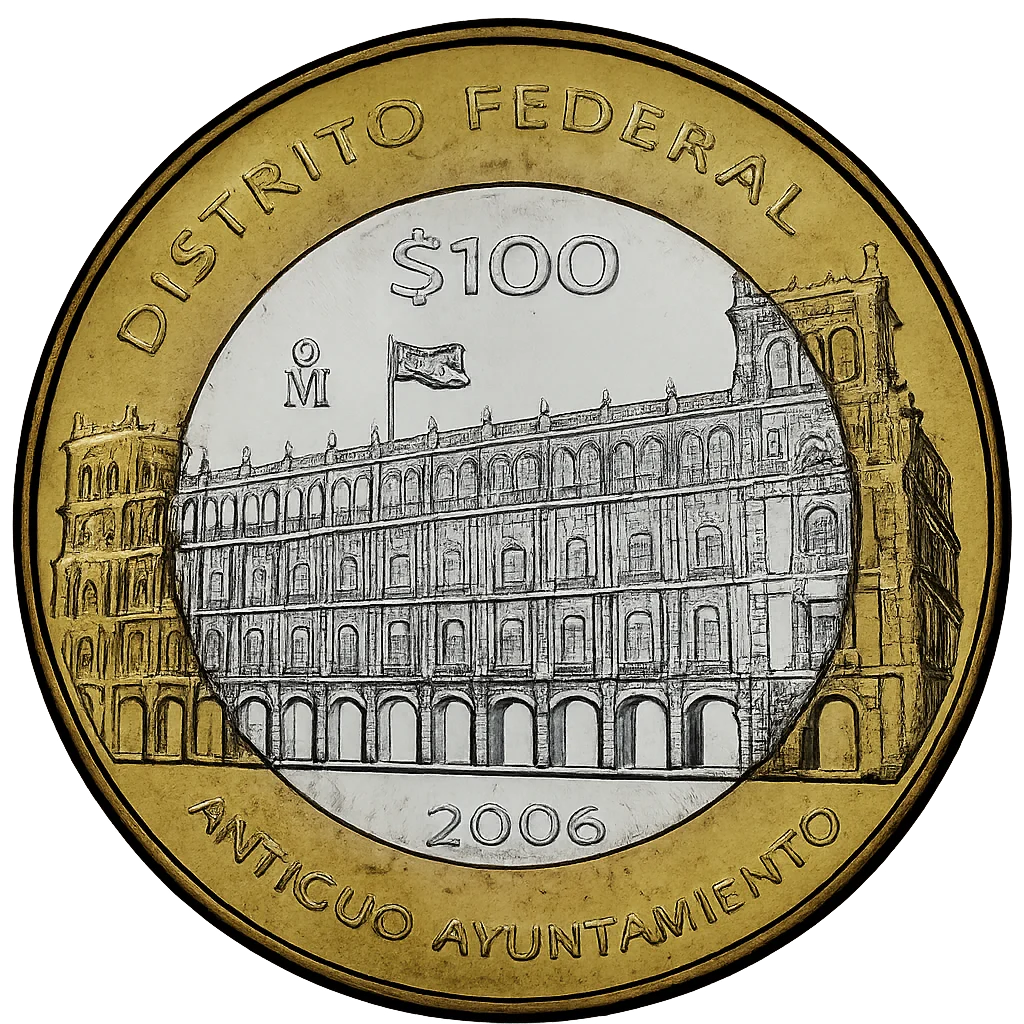
Phase two, the Cultural series. Here Banxico changed the approach. Instead of the coat of arms, the reverse shows a cultural element or a landmark that represents the state. This is the more eye-catching version, the one with real design personality. Most of these pieces are dated 2005, but not all. Estado de México came out in 2006, and Sonora, Tabasco, and Tamaulipas in 2007. So if you are looking for the Cultural version of those four and the date is not 2005, that is correct, not a problem.
Those odd dates are not a quirk or a minting error. The official decree set the production windows for each phase. The Coat of Arms series was struck through December 31, 2006, in descending alphabetical order (starting with Zacatecas, ending with Aguascalientes). The Cultural series was struck from May 2, 2004, through December 31, 2007, in ascending alphabetical order, the reverse (from Aguascalientes toward Zacatecas). Because the Cultural window ran to late 2007, the last states carried 2006 and 2007 dates. That is why Estado de México, Sonora, Tabasco, and Tamaulipas are not 2005: they were at the end of the line.
So each state has two coins: its Coat of Arms 2003 and its Cultural. 32 times 2 equals 64 pieces. A complete set is 64. If you settle for one version, it is 32.
| Version | Date | What the reverse shows | Official minting order |
|---|---|---|---|
| Coat of Arms | 2003 | The state's coat of arms | Descending alphabetical (Zacatecas to Aguascalientes) |
| Cultural | 2005 (some 2006/2007) | A cultural element or landmark | Ascending alphabetical (Aguascalientes to Zacatecas) |
The Cultural Version Is the Standout
If the Coat of Arms series is the formal version, the Cultural is the one collectors fall for. Banxico stopped repeating the official emblem and portrayed what actually makes each state distinct: a monument, an archaeological site, a historic building, an element of local identity. Seen together, the 32 Cultural coins are close to a tour of the country.
This was deliberate. The official decree fixed the rules: each Cultural motif had to come from a specific list of themes, architecture, art, science, fauna, flora, traditional costumes or dances, or geographic areas of interest in the state. Each state proposed its own motif within those categories, and if a state did not submit one in time, Banxico designed it. So when you see the Cultural coin for a given state and wonder why they chose that monument or species or building, the answer is that someone in that entity proposed it within those seven official categories.
Some choices follow naturally from a state's history. Yucatán is Maya country, home to Chichén Itzá, so its Cultural coin leans into that Maya legacy. Mexico City carries centuries of history, from the Templo Mayor to the historic center. Oaxaca has among the strongest Indigenous and archaeological identities in the country, with Monte Albán and Mitla nearby. Chiapas, with Palenque and its jungle, draws on its own heritage as well.
The general rule holds: each Cultural coin shows a monument or a representative symbol of that entity. Treat the series as a themed collection, not just 32 silver discs. It is a cultural map of Mexico struck in metal, assembled piece by piece.
Composition: Why the Silver Center Matters
This is what truly separates these coins from any bimetallic piece in your pocket. The silver center is real. According to the official decree published in the Diario Oficial de la Federación (DOF, Mexico's federal gazette), the circulating coin (the common one, the one most people have) carries a Sterling silver center at .925 fineness, with 15.552 grams of pure silver inside. That is half a troy ounce of silver in the heart of the coin. It is not .999, it is .925 Sterling, and that is the correct figure for the everyday piece.
This matters because there is a lot of confusion here, and that confusion is what a dishonest seller exploits. You will see claims that these coins are .999 or pure silver. For the circulating coin, that is wrong. A .999 version does exist in this series, but in two separate versions that almost nobody owns, covered in the next section. The one people hold is Sterling .925.
The decree also fixes the exact specs: 39 mm diameter, interrupted reeded edge, the Mo mint mark of the Casa de Moneda de México on the reverse, a beaded rim around it. The silver center weighs 16.812 grams total, of which 15.552 grams are pure silver and the rest is alloy copper. The ring around that center is a bronze-aluminum alloy, not silver. These numbers are your tool for verifying that a piece is legitimate and not a replica.
Why does the silver center matter? Two reasons.
The first is physical. A coin with a silver center weighs differently, feels different, and ages differently. Silver is a noble metal, but it reacts: it can spot, it can darken if stored poorly, handled with sweaty fingers, or left in a cheap capsule that offers no protection. Condition carries double weight on these pieces. A spotted or oxidized silver center drops the appeal sharply.
The second is value. That silver center gives the piece a floor, a metal value that a pure cupronickel coin does not have. But here is the constant warning, repeated below: the value of these coins is not in the silver weight, it is in the collection. Silver is the floor, not the ceiling. Anyone selling it as a disguised bullion bar is playing you.
When you inspect one, check that center first. It should have luster, no dullness, no black or greenish oxidation spots. Well-kept silver looks clean and bright. Mistreated silver is obvious. Always compare against the catalog photo before deciding.
It Is Not One Coin, It Is Three: Circulating, Pure Silver, and Gold
This is the distinction that separates people who know from people who do not, and the reason you see prices online that do not add up. Read the full official decree and you find something rarely explained: under the same name and with the same motif, Banxico struck three different versions of this coin, each in a different metal. These are not the same piece at different prices. They are three different coins. That is why one person tells you their 100-peso coin is worth a fortune and another says theirs is worth little, and both can be right.
The circulating bimetallic coin. This is the common one. It comes from Article One of the decree, the one people carry, the one in the Pesoteca catalog. Sterling silver center at .925 with half a troy ounce of pure silver inside, bronze-aluminum ring, 39 mm. This is the one you collect by state, the one the everyday Mexican collector chases. When this article refers to the 64 pieces, this is what it means. It is genuine silver, yes, but not pure silver.
The pure silver ounce. This is a different thing entirely. Article Two of the decree establishes a version with a face value of 10 pesos (not 100), .999 fineness, a full troy ounce of pure silver, 40 mm. It is a separate numismatic piece, struck in smaller quantities and headed straight to collections. If someone offers you a "state 100-peso coin in .999 pure silver," be careful: either they are confusing the circulating coin with this one, or they genuinely have the ounce, which is a different and more expensive coin.
The deluxe bimetallic, gold plus silver. This is the premium. Article Three describes the crown jewel of the series: a pure gold center at .999 and a pure silver ring at .999, 34.5 mm, smooth edge. Gold and silver, both pure. This is the high-end collector version, the one almost nobody has and the one that reaches the highest prices. If you see a state 100-peso coin priced very high, it is probably this one, not the circulating coin.
| Version | Metal | Fineness | Face value | Diameter |
|---|---|---|---|---|
| Circulating (common) | Sterling silver + bronze-aluminum | .925 | 100 pesos | 39 mm |
| Pure silver ounce | Pure silver | .999 | 10 pesos | 40 mm |
| Deluxe gold and silver | Pure gold + pure silver | .999 | 100 pesos | 34.5 mm |
So when someone asks what their state 100-peso coin is worth, the first question back is: which of the three? The circulating Sterling .925 is what almost everyone has and what the rest of this guide covers. The .999 pieces, the ounce and the gold version, are separate, rarer, and pricier. Do not confuse them with the common one just because they share a name. That mix-up is exactly what a dishonest seller uses to sell you a common coin at a premium price, or to pay you a premium price for a common coin if you are the one selling.
The Complete List by State
Here are all 64, grouped by region for easier navigation. Each state links to its Coat of Arms and its Cultural version.
North
- Baja California: Coat of Arms 2003 · Cultural 2005
- Baja California Sur: Coat of Arms 2003 · Cultural 2005
- Chihuahua: Coat of Arms 2003 · Cultural 2005
- Coahuila: Coat of Arms 2003 · Cultural 2005
- Durango: Coat of Arms 2003 · Cultural 2005
- Nuevo León: Coat of Arms 2003 · Cultural 2005
- Sinaloa: Coat of Arms 2003 · Cultural 2005
- Sonora: Coat of Arms 2003 · Cultural 2007
- Tamaulipas: Coat of Arms 2003 · Cultural 2007
Central
- Aguascalientes: Coat of Arms 2003 · Cultural 2005
- Mexico City: Coat of Arms 2003 · Cultural 2005
- Colima: Coat of Arms 2003 · Cultural 2005
- Estado de México: Coat of Arms 2003 · Cultural 2006
- Guanajuato: Coat of Arms 2003 · Cultural 2005
- Hidalgo: Coat of Arms 2003 · Cultural 2005
- Jalisco: Coat of Arms 2003 · Cultural 2005
- Michoacán: Coat of Arms 2003 · Cultural 2005
- Morelos: Coat of Arms 2003 · Cultural 2005
- Nayarit: Coat of Arms 2003 · Cultural 2005
- Puebla: Coat of Arms 2003 · Cultural 2005
- Querétaro: Coat of Arms 2003 · Cultural 2005
- San Luis Potosí: Coat of Arms 2003 · Cultural 2005
- Tlaxcala: Coat of Arms 2003 · Cultural 2005
- Zacatecas: Coat of Arms 2003 · Cultural 2005
South and Southeast
- Campeche: Coat of Arms 2003 · Cultural 2005
- Chiapas: Coat of Arms 2003 · Cultural 2005
- Guerrero: Coat of Arms 2003 · Cultural 2005
- Oaxaca: Coat of Arms 2003 · Cultural 2005
- Quintana Roo: Coat of Arms 2003 · Cultural 2005
- Tabasco: Coat of Arms 2003 · Cultural 2007
- Veracruz: Coat of Arms 2003 · Cultural 2005
- Yucatán: Coat of Arms 2003 · Cultural 2005
That is 32 states, each with two versions. Count them: 64 pieces.
Why This Is the Set Collectors Want to Complete
Three things make it distinct.
First is the silver. That center gives the coin real weight, both physical and symbolic. Collecting circulating coins is not the same feeling as collecting silver dedicated to your home state.
Second is the personal angle. Everyone is from somewhere. A collector from Michoacán wants the Michoacán coin, someone from Mexico City wants theirs, someone from Nuevo León wants that one. This is one of the few series where the coin speaks to you directly, because it carries your state.
Third is the beauty of the Cultural phase. When Banxico shifted from the coat of arms to a cultural element, the coins gained character. Each reverse is different, with a monument or symbol of the entity. Seeing all 32 Cultural coins together is seeing a cultural map of the country in silver.
An honest note: you do not have to chase all 64 at once. Many people start with their own state, then a parent's state, then the state where they live. It builds itself. Closing all 64 is a long-term goal, and that is fine.
Strategies to Complete the 32 (or the 64)
Diving in without a plan is the easiest way to overspend and get frustrated. Here are routes that actually work.
Start with your own state. The obvious choice and the right one. Your home coin carries the most meaning and gives you the most drive to keep going. Get it in both the Coat of Arms and Cultural versions, and you already have two of 64.
By version: complete the Coat of Arms set first, then the Cultural. Good if you like order. All 32 Coat of Arms coins are 2003, so it is a uniform, closed block. Then take on the 32 Cultural coins, the more striking block.
By version, reversed: go straight for the Cultural coins. Many collectors only want the attractive ones. If your time or budget does not stretch to 64, the 32 Cultural coins make a complete, characterful collection. A complete set of one version is still a complete set.
By region. If you are from the north, gather Baja California, Chihuahua, Coahuila, Nuevo León, and neighbors first. Closing geographic blocks gives you small, reachable goals instead of one mountain of 64. At shows and in groups, someone sometimes sells a lot of neighboring states together.
By personal connection. Your state, a parent's state, the state where you studied, where your partner lives. Every piece has a reason. This is the most rewarding route for someone collecting for enjoyment rather than completeness.
Whatever route you pick, track your progress. Note what you have in each version. The Pesoteca digital collection tracker is built for exactly that: marking what you already own and seeing at a glance what is missing.
Which Ones Are Harder to Find
An honest answer: Banxico does not publish the exact mintages of all 64 in one clear, easy-to-read place, and we will not invent numbers. What we can give you are the general signals that make a piece harder to find. Use them as a compass, not as hard data.
The Cultural coins with odd dates. Remember that Sonora, Tabasco, and Tamaulipas came out in 2007, and Estado de México in 2006. Released in a different year from the bulk of the series, they were sometimes distributed or held differently, and they appear less often on the secondary market than the common 2005 coins. Not an iron rule, but a pattern many collectors notice.
Coins from smaller or less locally collected states. Odd as it sounds, a coin from a state with fewer active collectors shows up less often in groups, simply because fewer people are moving it. Not rarer at the source, just less often crossing the market.
Coins already held by serious collectors. Many of these are already gathered, in capsules, in closed collections that will not break up. That reduces the supply in circulation. The ones loose at shows are what you can hunt.
Our advice: do not obsess over guessing the hardest one up front. Start collecting, and the tough ones reveal themselves once you have 50 and are missing the same ones everyone else is missing.
The Investment Angle: Silver Plus Collecting
People often ask whether these coins are a good investment. The answer is nuanced, and here it is without the hype.
On one side, yes, they have a silver floor. The center is genuine silver, and silver as a metal has its own market value that rises and falls. That gives the coin a floor a pure cupronickel piece will never have.
But, and this is a big but, the real value of these pieces is not the silver weight. It is the collecting. A well-preserved coin from this series, uncirculated, with a clean silver center, is worth what it is: a piece dedicated to a state, part of a set people want to complete. That collector value is what makes it interesting, not the weight in silver.
So, are they an investment? As a collection, they can be, if you store them well and demand to complete the series holds. As disguised silver bullion, no. If someone tries to sell one purely on its silver content times the metal price, be skeptical: they are ignoring the most valuable thing, that it is a coin from this series.
Our stance: buy it because you like it, because it is your state's coin, because you want to close the set. If it appreciates over time, good. But do not enter this thinking you will run a metals business.
Mistakes When Buying Your State's Coin
This part saves you money. These are the classic slip-ups we see with this series.
Confusing the Coat of Arms with the Cultural. The most common beginner error. Someone offers you your state's coin and you think there is only one, when there are two. Sometimes a seller passes off the Coat of Arms 2003 as the attractive Cultural, or the reverse. Learn to tell them apart at a glance: coat of arms on the reverse is the Coat of Arms version; a monument or cultural element is the Cultural. Check the date too. Do not pay one price for the other.
Paying rarity prices for a common piece. The seller paints the coin as extremely rare to justify a markup. The story is easy to build with these coins because they contain silver. Do not hand over money just because a shop owner said it was hard to find. Compare with the catalog listing and with prices in collector groups before paying.
Buying a circulated coin as if it were uncirculated. You get sold a worn coin, with a spotted or dull silver center, at the price of a fresh uncirculated piece. Check the silver center under light: it should shine, with no scratches or black spots. A circulated coin is worth less, period.
Falling for a fake. With pieces that contain silver, there is always a counterfeit risk. Some replica, some center that is not real silver. If the price is suspiciously low or the seller does not inspire confidence, walk away. Another will come. A series this long always gives second chances.
Not inspecting before paying. The error that covers all the rest. Before handing over money, have the catalog listing open, compare the design, the date, the state of the silver center. If something is off, it is off. Haste is the reseller's friend.
How to Find Your State's Coin
You will not get these at a bank anymore. They came out about twenty years ago, so they are hunted on the secondary market: coin shops, shows, and collector groups.
In Mexico City, they turn up in downtown shops and at coin shows. If you are elsewhere, Facebook groups like Numismática Mexicana are a good starting point to ask and compare. Do not rush: if one slips by, another will come. This is a series that does move.
Before handing over money, inspect the silver center: no spotting or oxidation, good luster. Compare with the coin's listing here on Pesoteca before you pay. If the seller does not inspire confidence, walk away.
And do not mix it up: the value of these pieces is in the collection, in gathering your state and closing the set, not in the metal by the gram. Do not fall for anyone selling it as a pure silver investment.
Do you already have your state's coin? Post it in the forum and share it, someone else from your state is hunting for theirs. And which one have you spent years unable to close? Say so there, someone may have it stored away. If you are going for the full set, check the 100 pesos Estados series hub and the shop directory to find where to get the ones you are missing.

Loading comments…