
En resumen
Collecting paper money is called notaphily. Here's what makes a Mexican banknote worth more than its face value, which ones collectors chase, and how to start without getting ripped off.
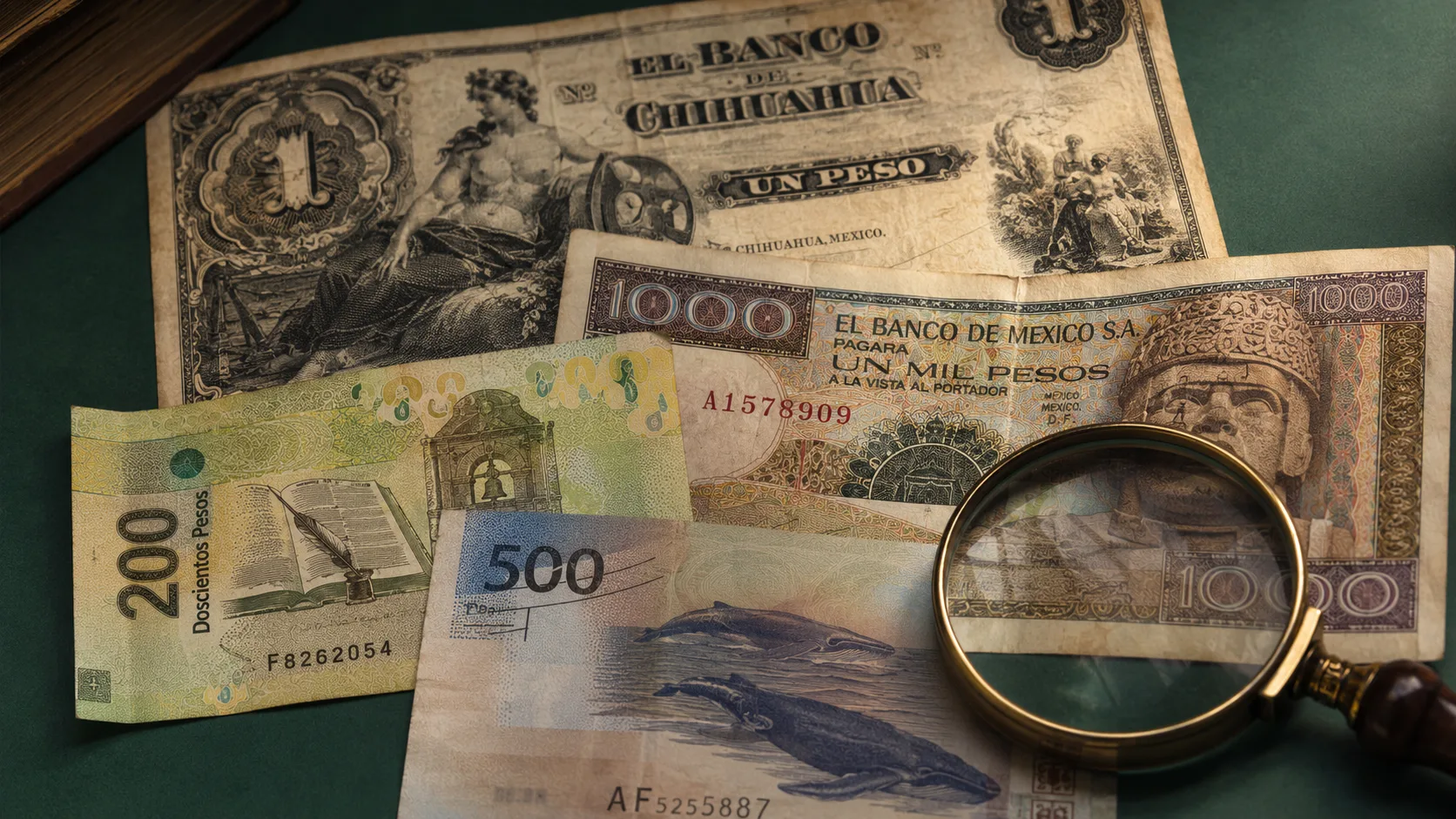
Most inherited Mexican banknotes are worth face value or a few dollars. But a private bank note from the 1800s, a Revolution-era issue, or a modern bill with a rare serial number can bring hundreds or even thousands. Collecting paper money has its own name, and Mexico is one of the richest countries to do it in.
What paper money collecting is
The hobby of collecting banknotes is called notaphily (in Spanish, notafilia). It is the collection and study of paper money: banknotes, but also scrip, bonds, and other documents that once circulated as money. It sits right next to coin collecting, only you gather paper instead of metal.
In practice, Mexican notaphily overlaps constantly with Mexican numismatics: many people who collect coins also keep banknotes, and the market is essentially the same. The one real difference is fragility. A coin survives decades in a drawer; a banknote gets ruined by a single fold, humidity, or sunlight. That is why condition matters even more with paper than with coins.
A short history: why Mexico has so many banknotes
To understand the sheer variety, you have to go back. For much of the 1800s and early 1900s, Mexico had no single central bank printing the money. Instead, the government authorized private banks in each state to issue their own paper, backed by silver: take the note to the bank, and they would exchange it for real silver coins.
That is why there are so many banknotes from the Porfiriato (the long rule of Porfirio Díaz, roughly 1876 to 1911): the Banco de Zacatecas, the Banco Yucateco, the Banco Mercantil de Yucatán, the Banco de Jalisco, and dozens more, each with its own design, city, and engravings. When the Revolution broke out in 1910, the system collapsed. Each faction (Carranza, Villa, local governments) started printing its own money to pay its troops, and for a time so many different issues circulated that people no longer knew which ones held value.
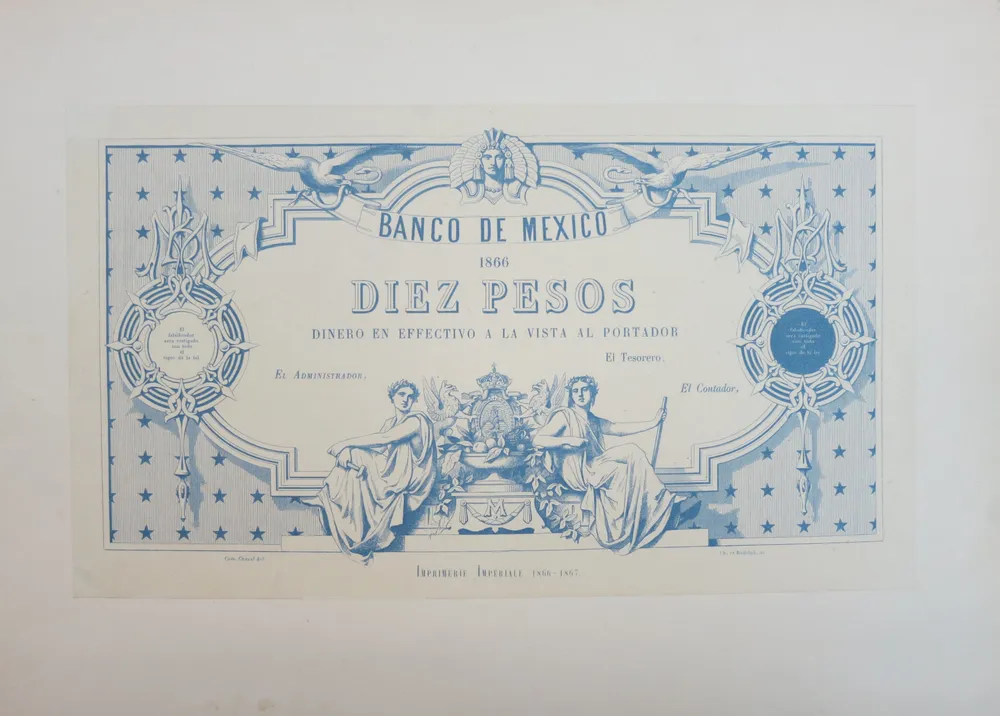 Banco de México from 1866, Second Empire era, one of the oldest and rarest issues in the country">
Some issues are genuine museum pieces. The Banco de México note of 1866, from the Second Empire of Maximilian, is one of the oldest in the country, and several surviving examples are bank proofs of extreme rarity.
Order arrived in 1925 with the founding of the Banco de México, which from then on held a monopoly on issuing currency. Every Mexican banknote since is a Banco de México note, but that does not make them dull. They ran through the inflation era (with notes up to 100,000 pesos), the 1993 currency reform that lopped off three zeros, the switch to polymer, and the modern series. Each stage left its mark on paper.
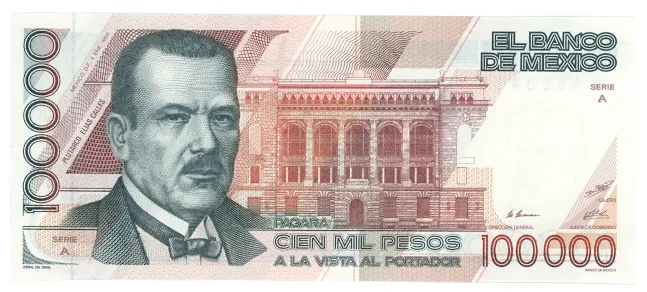
That 100,000 peso note with Plutarco Elías Calles is a good reminder of how far inflation went: 100,000 pesos that, after the 1993 reform, were worth 100 new pesos. Today it is a curiosity that surprises many people simply because it existed.
Why Mexico is a great country for collecting banknotes
Mexico has a long, varied history of paper money, which means pieces for every taste and budget:
- Private banks of the Porfiriato (1864 to 1925). Before the Banco de México existed, dozens of state banks printed their own silver-backed notes: the Banco de Zacatecas, the Banco Yucateco, the Banco de Jalisco. These carry beautiful allegorical engravings and a lot of regional history.
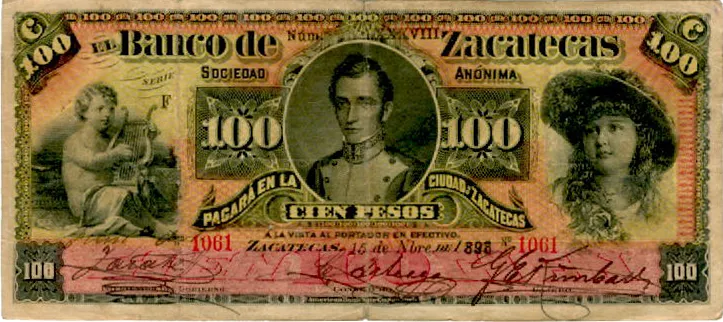
The vignettes were not random decoration. The Banco de Zacatecas filled its notes with miners because silver ore was exactly what backed the paper. Each bank told the economic story of its region.
- The Revolution. Every faction issued its own paper: scrip from Carranza's Constitutionalist Government, treasury obligations, even checks from the Bank of Montreal in Pachuca. Monetary chaos turned into collectible objects.
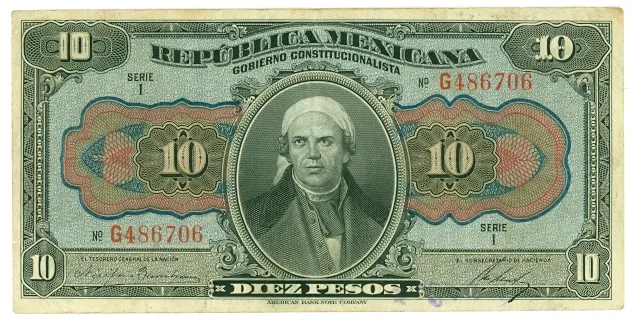
The 10 peso note of the Constitutionalist Government is one example: Carranza issued his own paper money to finance the fight and to give his government legitimacy against Villa and Zapata. It is Revolution history you can hold in your hand.
-
The inflation era (1970 to 1988). Notes that climbed all the way to 100,000 pesos, featuring Cuauhtémoc, Justo Sierra, or Plutarco Elías Calles. A surprising detail: the 500 peso note of 1979 showed Francisco I. Madero on the front and the Aztec Sun Stone on the back, and it entered circulation on November 20, the anniversary of the start of the Revolution. Details like this are documented in the Banco de México's official circulars.
-
The old pesos and the modern series. From the New Peso notes of 1992 to the first polymer note (the 20 peso Juárez note) up to the current Family G, with the famous 50 peso axolotl note.
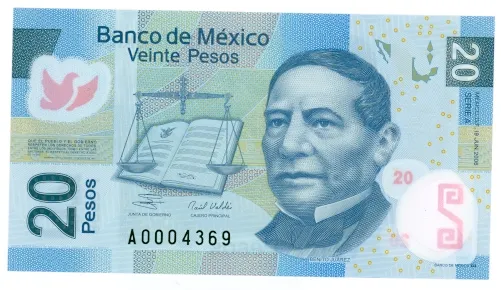
You can see all of this organized by series in the Mexican banknote catalog.
How to tell if a banknote is worth anything
This is where the ordinary note gets separated from the one that matters. Four things drive value, in this order:
- Condition. An uncirculated note (no folds, no stains, corners intact) is worth far more than the same note worn down. This is the number one factor, above age.
- Serial number. Low serials (like 0000001), palindromes (that read the same forward and backward), and repeated digits are hunted by collectors.
- Printing errors. Misaligned cuts, ink smears, factory folds. An error turns a common note into a rarity.
- Rarity of the issuer or year. A private Porfiriato bank note or a low-mintage commemorative is worth more because it is scarce.
What does not determine value on its own is age. There are bank notes over a hundred years old that are relatively common, and modern notes worth more for an error or a serial number. Do not fall for "it's old, so it's valuable." To place yours, use the what is my banknote worth tool.
How to read a banknote: front, back, and grades
Before you collect seriously, it helps to read a note the way a collector does. Two sides and a vocabulary:
- Front (anverso). This is where the main figure, the denomination, and the signatures go. In its official circulars, the Banco de México describes each front in detail: the 1979 500 peso note, for example, carries "the effigy of don Francisco I. Madero, printed in relief in dark green," hand-engraved to make counterfeiting harder.
- Back (reverso). Usually a cultural or natural motif: an archaeological site, a monument, an ecosystem. The back of the 2,000 peso Justo Sierra note, according to Banxico, shows "the arcade of the courtyard of the University of Mexico building, as it was in the 19th century."
- Grade of preservation. Here the vocabulary is borrowed from coin grading. A note graded UNC (uncirculated) is exactly as it left the factory. From there it drops: about uncirculated, very fine, and so on down to a worn, folded note. Each step down can cut the price in half.
Learning to read both sides has a practical payoff: telling a legitimate note from a reprint or a counterfeit, and knowing what you are buying before you pay.
How to care for and store your banknotes
This is what separates someone who piles up notes from someone who preserves them well. Paper is delicate, and poor storage destroys value:
- Never fold them. An uncirculated note loses its grade at the first fold. Store them flat.
- Use mylar or polypropylene sleeves, no PVC. PVC releases chemicals over time and stains the paper. Archival-quality sleeves are cheap and save the piece.
- Away from light, humidity, and heat. Sun fades the inks, humidity causes "foxing" (those little brown spots), and heat dries out the paper. A drawer or album in a cool, dry place is enough.
- Do not "restore" or iron them. Just as you should never clean a coin, you should never iron or wash a banknote. Any intervention shows and lowers the value.
- Do not glue or tape them. It sounds obvious, but plenty of historic pieces arrived ruined by adhesive tape put on "to repair" them.
Watch out for inflated online prices
As with coins, paper money has its share of inflated internet prices. You see a note "selling for" a fortune on some platform, and it turns out to be a listing, not a real sale. Nobody bought it at that price.
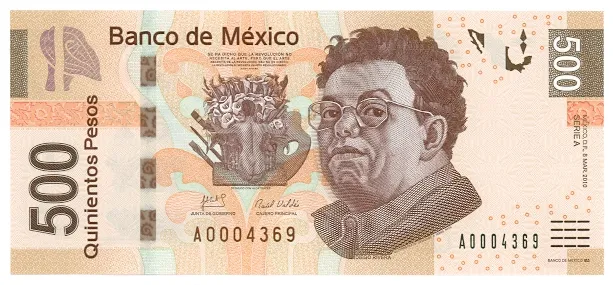
The classic case is the 500 peso note of Diego Rivera and Frida Kahlo: it gets listed sky-high because it is one of the most beautiful Mexico ever made, but the real price depends on condition, not the portrait. The rule is the same as with Mexican coins: the asking price is not the selling price. A note is worth what someone actually pays for it, and that depends on condition and current demand. Before selling something you think is valuable, ask in the forum or check with a serious numismatic shop from the directory.
How to start your collection
You do not need money to begin. The cheapest way to start is to keep the notes already leaving circulation: the Family F notes (the blue 20 peso Juárez, the pink 50 peso Morelos) are being withdrawn right now. Get one uncirculated, store it well, and you have your first piece with potential.
From there, everyone builds a theme: by denomination, by series, by era, by figure. Some collect only Revolution notes, some chase the private banks, some want the complete Family G. There is no correct way: you collect what you like.
Where to find banknotes
The paper money market is essentially the same as the coin market, so if you already know numismatics, you know the places:
- Facebook groups. Where most people learn and where most collector-to-collector trading happens. You see real prices there, not asking prices.
- Numismatic conventions. Several times a year there are conventions trading both coins and banknotes. A good place for specific pieces and for learning from veterans.
- Established numismatic shops. For valuable pieces, go to an established shop rather than an anonymous seller. Check the shop directory by city.
The golden rule for beginners: learn first, buy second. A while spent watching real prices in the groups saves you from overpaying on your first piece.
Quick collector glossary
- Notaphily: the collecting of paper money.
- Face value: the nominal value printed on the note.
- UNC: uncirculated, exactly as it left the factory. The highest grade.
- Serial number: the note's identifying number. Low, palindromic, or repeated numbers are worth more.
- Palindrome serial: a serial that reads the same forward and backward (for example 1234321).
- Overstamp (resello): a stamp applied over an already-printed note, common in the merger of Porfiriato banks (the "Banco Peninsular Mexicano" over Banco Yucateco notes).
- Specimen or proof: a sample note, not issued for circulation. Many surviving 1866 notes are proofs.
- Demonetized: a note that is no longer legal tender, though it may still hold collector value.
Value at a glance
| Type of note | Era | What drives the price |
|---|---|---|
| Banco de México 1866, 10 pesos | Second Empire | Extreme rarity, many surviving examples are proofs |
| Private bank notes (Zacatecas, Yucateco) | Porfiriato, 1864 to 1925 | Issuer, condition, regional demand |
| Revolution scrip (Constitutionalist) | 1910 to 1917 | Historical interest, faction, condition |
| 100,000 peso, Plutarco Elías Calles | Inflation, 1988 | Curiosity value, condition |
| 500 peso Rivera and Frida Kahlo | 2010 | Condition and serial number, not the portrait |
| Family F (20 Juárez, 50 Morelos) | Being withdrawn now | Uncirculated grade, entry-level potential |
Got a note with a strange serial number, a printing error, or from a bank we have not cataloged yet? Send us a photo in the forum and the community will help identify it. Every piece that turns up makes the banknote catalog more complete for whoever comes next.

Loading comments…